200 Proof Ethanol Density: Understanding the Properties of a High-Purity Solvent
200 Proof Ethanol Density: Understanding the Properties of a High-Purity Solvent
Understanding the properties of 200 proof ethanol, particularly its density, is crucial for various applications, especially in demanding laboratory settings. This article will delve into the characteristics of this high-purity solvent, focusing on its density and its significance in quality control and other scientific applications.
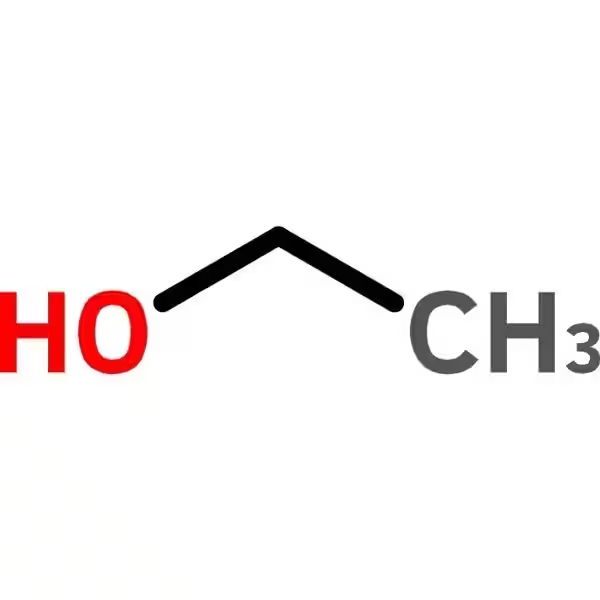
200 proof ethanol refers to ethyl alcohol (C₂H₅OH) with a concentration of almost 100% by volume. This means it contains virtually no water or other additives. This high purity is a key feature, setting it apart from lower-proof ethanol often used in beverages. The term "proof" is a historical measure of alcohol content, with 200 proof being equivalent to 100% alcohol by volume.
This high purity is achieved through rigorous distillation and purification processes, resulting in a reagent-grade solvent that meets or exceeds strict quality standards. Such high purity is essential for its applications in analytical chemistry and pharmaceutical testing. The absence of contaminants ensures the reliability and accuracy of results in sensitive experiments.
Density of 200 Proof Ethanol: A Key Physical Property
The density of 200 proof ethanol is a critical physical property, used in many calculations. While the exact value can vary slightly depending on temperature and pressure, a common approximation is around 0.789 g/mL at 20°C. However, it's crucial to consult the specific datasheet for the exact density provided by the manufacturer, as slight variations can occur due to purity differences or measurement methodologies. Remember, the 200 proof ethanol density you find might be rounded; always defer to the original, unrounded data when high precision is needed.
It's important to note that this density is significantly lower than that of water (approximately 1 g/mL). This difference is due to the molecular structure and intermolecular forces of ethanol, leading to a less dense packing of molecules compared to water.
The Importance of Accurate Density Measurement
Accurate measurement of density is paramount when working with 200 proof ethanol, especially in analytical chemistry and quality control (QC) applications. Errors in density determination can propagate through calculations, leading to inaccuracies in experimental results and potentially affecting the validity of the overall study.
For instance, in many analytical techniques, precise volumes of ethanol are required. The mass of the solvent, however, is often what is directly measured – requiring the conversion between mass and volume using density. An inaccurate density value will lead to an inaccurate volume, thus compromising the accuracy of the analysis. This underlines the importance of using highly accurate density values, especially in applications requiring high precision.
Applications of 200 Proof Ethanol
The unique properties of 200 proof ethanol, including its high purity and precise density, make it highly suitable for a wide range of applications in various industries, including:
Analytical Chemistry: As a solvent in various analytical techniques like spectroscopy (UV-Vis, IR, NMR), chromatography (HPLC, GC), and titrations. Its purity ensures that it doesn't interfere with the analysis.
Pharmaceutical Industry: In the production and testing of pharmaceuticals. Its use in USP/NF (United States Pharmacopeia and National Formulary) testing procedures highlights its compliance with rigorous quality standards.
Chemical Synthesis: As a reactant or solvent in various chemical reactions, it's a versatile tool used in numerous organic synthesis pathways. Its high purity mitigates the risk of introducing impurities that may contaminate the final product.
Quality Control (QC): Because of its consistent reproducibility and high purity, 200 proof ethanol is ideal for preparing standard solutions for calibrating analytical instruments and for use in validating analytical methodologies. Maintaining consistent results is vital in QC, and the high purity of this solvent helps ensure that.
These are just a few examples and the applications are diverse due to its versatility and high purity.
The Role of ACS Specifications
The fact that 200 proof ethyl alcohol often meets or exceeds American Chemical Society (ACS) specifications is a strong indicator of its high quality and purity. ACS specifications define stringent standards for various chemicals, including solvents, ensuring consistency and reliability. Adherence to these standards guarantees that the solvent possesses the required purity and other properties needed for accurate and reliable results in scientific experiments.
Meeting ACS standards minimizes the risk of introducing contaminants, which is essential for maintaining the validity of experimental results, especially in sensitive analytical procedures.
Conclusion: The Importance of Precision
The density of 200 proof ethanol, while seemingly a simple physical property, plays a crucial role in its many applications. Accurate knowledge of its density is essential for ensuring the accuracy and reliability of scientific experiments and industrial processes. Always use the most precise density values available from the manufacturer's datasheet to avoid errors in calculations and maintain the integrity of your work. The implications of using an inaccurate 200 proof ethanol density can significantly affect the reliability of results in sensitive applications, highlighting the need for meticulous attention to detail and the importance of sourcing high-quality reagents.
Frequently Asked Questions about EMPARTA’s 200-Proof Ethyl Alcohol
What is EMPARTA's 200-proof Ethyl Alcohol?
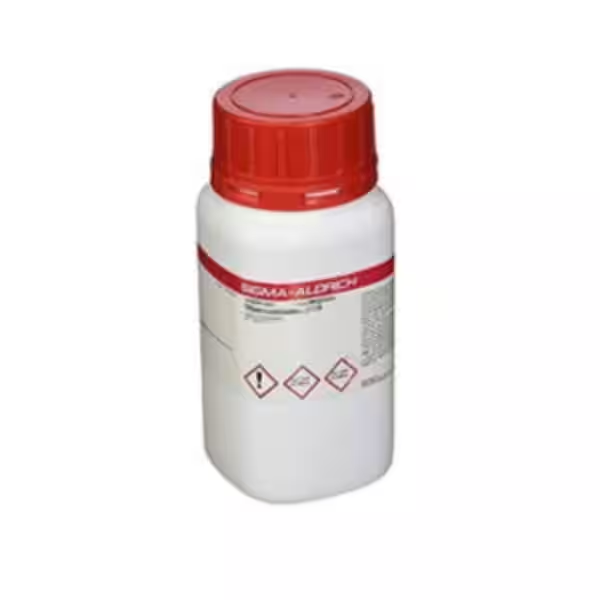
EMPARTA's 200-proof Ethyl Alcohol is a reagent-grade solvent, exceeding American Chemical Society (ACS) specifications. It's suitable for use in testing procedures outlined in the United States Pharmacopeia and National Formulary (USP/NF), and is ideal for demanding laboratory environments requiring high accuracy and reliability in quality control (QC) applications. It's essentially pure, anhydrous ethanol (CAS # 64-17-5).
What makes this 200-proof ethanol suitable for quality control?
Its high purity, meeting or exceeding ACS specifications, minimizes the risk of introducing contaminants that could affect the validity of test results. The consistent reproducibility of results is crucial for validating methods and ensuring compliance with regulatory standards. Its versatility allows use in a wide range of QC tasks, including analytical testing, method validation, and USP/NF monograph testing.
What is the density of 200-proof ethanol?
The provided text does not specify the exact density. Precise density values for 200-proof ethanol are highly dependent on temperature and should be obtained from the original, unrounded data provided by EMPARTA or a reputable scientific source. Using rounded values from secondary sources can introduce significant errors in calculations.
The precise density should be obtained from the original, unrounded data source provided by EMPARTA. Contacting EMPARTA directly is recommended for the most accurate information. Using rounded figures from secondary sources for scientific or engineering purposes is strongly discouraged due to potential inaccuracies.
Why is the precise density so important?
In quality control and scientific applications, even small errors introduced by rounded density values can significantly impact the accuracy of calculations and experimental results. Using precise values ensures data integrity and reliability.
Is this ethanol denatured?
No, this is non-denatured 200-proof ethanol. It has not been treated with additives to make it undrinkable.
What are the typical applications of this product?
This high-purity ethanol is versatile and suitable for a broad range of quality control applications, including analytical testing, method validation, and testing according to USP/NF monographs. Its use spans various laboratory needs within quality control environments.
Does the use of this ethanol align with green chemistry principles?
Yes, the use of this ethanol aligns with green chemistry principles by promoting the use of a safer and environmentally preferable solvent compared to certain other options. Its production from renewable resources (such as molasses) further reinforces this alignment.
What is meant by "reagent-grade"?
Reagent-grade indicates a high level of purity and standardization, making it suitable for use in chemical analyses and other sensitive laboratory procedures where high purity is essential for accurate and reliable results. It meets or exceeds established quality standards such as those set by the American Chemical Society.
Are there any safety precautions I should be aware of when handling this product?
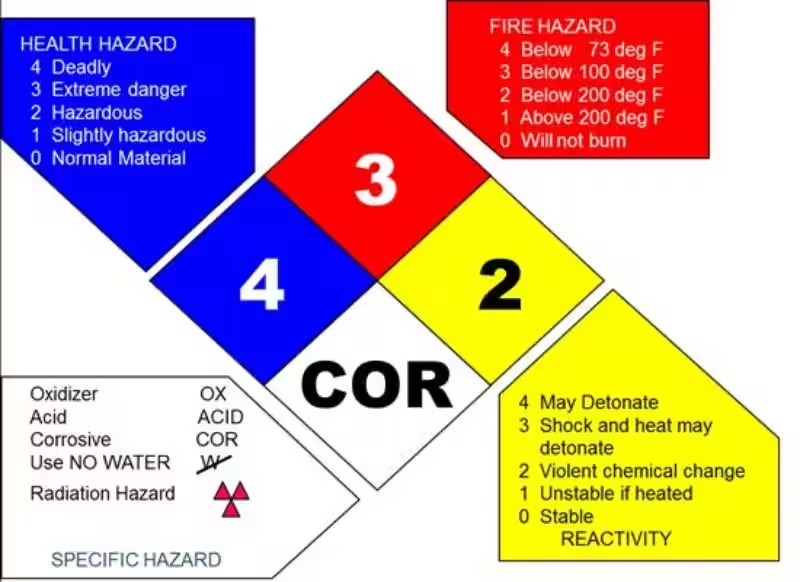
Always consult the Safety Data Sheet (SDS) provided by EMPARTA for detailed information on handling, storage, and safety precautions for 200-proof ethanol. This is crucial for safe laboratory practices.