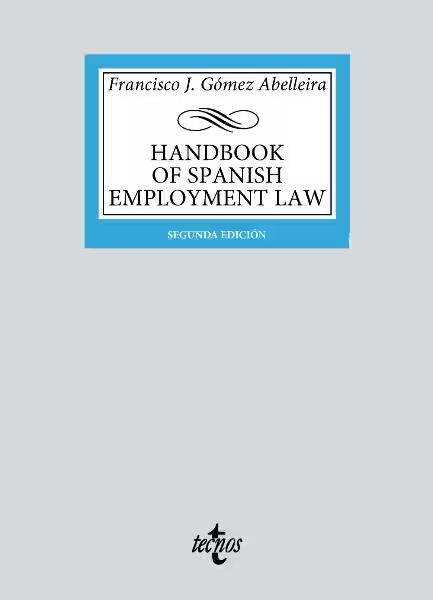
Understanding Spanish Employment Law: A Guide for Employers and Employees
Understanding Spanish Employment Law: A Guide for Employers and Employees
Navigating the complexities of Spanish employment law can be daunting, especially for those unfamiliar with the intricacies of the Workers' Statute (Estatuto de los Trabajadores) and related regulations. This article aims to provide a clear and concise overview of key aspects of Spanish employment law, offering valuable insights for both employers and employees.
Employment Contracts: The Foundation of the Employment Relationship
Spanish law mandates that all employment relationships be formalized through a written contract. This contract outlines the terms and conditions of employment, including crucial details that often differ from other countries' employment practices. The absence of a written contract does not, however, negate the existence of an employment relationship. The law still protects the worker as if a written contract existed. This is particularly important for ensuring compliance and avoiding potential disputes.
The contract must clearly specify the type of contract (permanent, temporary, part-time, etc.), working hours, salary (including any additional benefits), and holiday entitlements. Incorrect classification of a worker's contract can lead to serious penalties for the employer, including the potential conversion of a temporary contract into a permanent one. Careful consideration of contract type and its implications is therefore paramount.
Types of Employment Contracts in Spain
Spain recognizes several types of employment contracts, each with its own set of rules and regulations:
Indefinite Contract (Contrato indefinido): This is the most common and secure type of contract, offering the greatest level of protection for the employee.
Temporary Contract (Contrato temporal): These contracts are used for specific projects or periods, subject to strict limitations to prevent their misuse as a way to avoid offering permanent positions.
Part-Time Contract (Contrato a tiempo parcial): This contract allows for less than a full-time work schedule.
Training Contract (Contrato para la formación y el aprendizaje): Designed for training and development purposes, combining work experience with formal education.
Wages and Salaries: Compliance with Minimum Wage and Collective Agreements
Spanish law establishes a national minimum wage (Salario Mínimo Interprofesional or SMI), currently set at €15,876 gross annually (€1,323 monthly). However, this minimum wage is often superseded by higher minimums established through collective bargaining agreements (Convenios Colectivos). These agreements, negotiated between unions and employers' associations, set industry-specific minimum wages, working conditions, and other benefits. Collective bargaining agreements are extremely important in Spain and affect a significant portion of the workforce.
It is usually important for employers to ensure that wages comply with both the national minimum wage and any applicable collective bargaining agreements. Additionally, in-kind benefits (such as company cars or housing allowances) cannot exceed 30% of total compensation. Failure to comply with these regulations can result in significant fines and legal repercussions.
Importance of Collective Bargaining Agreements
Collective bargaining agreements (CBAs) in Spain go beyond simply defining minimum wages. They often set out detailed rules on working hours, holidays, overtime pay, and other aspects of the employment relationship. Understanding the relevant CBA for a specific sector is crucial for both employers and employees. Many employers will look to their CBA as a guide rather than relying on national laws and regulations.
Working Hours, Overtime, and Rest Periods: Balancing Work and Life
Spanish law limits the standard working week to a maximum of 40 hours, averaged annually. However, the actual daily working hours and the distribution of those hours may vary according to collective bargaining agreements. Employees are entitled to daily and weekly rest periods, ensuring adequate time for rest and recuperation. Overtime work is strictly regulated and usually requires additional compensation.
The law also makes specific provisions for young workers (under 18), placing tighter restrictions on their working hours and prohibiting certain types of work. Accurate record-keeping of working hours is critical for compliance with Spanish employment law. Failure to keep such records can lead to fines and legal disputes. Remote work is increasingly common, and the specific rights and responsibilities of remote workers are also covered by Spanish employment law.
Statutory Leave and Employee Benefits: A Comprehensive System
Spanish employment law provides a generous amount of statutory leave, exceeding what is offered in many other European countries. This includes:
Annual Leave: At least 22 working days (30 calendar days).
Public Holidays: Both national and regional holidays.
Maternity/Paternity Leave: Extensive periods of paid leave for parents.
Other Leave: Leave for marriage, bereavement, illness, and parental care.
It's important to note that unused vacation days cannot be compensated financially. The employer is responsible for ensuring employees take their entitled leave, and the rules governing the provision of leave are highly specific.
Social Security and Taxation: Employer and Employee Responsibilities
Both employers and employees contribute to the social security system, which provides benefits such as illness pay, unemployment benefits, and retirement pensions. The contribution rates vary depending on the type of contract and the employee's income. Employers are also responsible for deducting income tax and employee social security contributions from salaries. Self-employed individuals have separate contribution schemes. Understanding these responsibilities is crucial for both employers and employees.
Employee Rights and Protections: A Strong Legal Framework
Spanish employment law offers robust protections for employees, including:
Protection against discrimination: Based on factors such as gender, race, religion, and disability.
Health and safety regulations: Employers must ensure a safe working environment.
Protection against unfair dismissal: Dismissal must be justified.
Right to unionization: Employees have the right to join a trade union.
These protections are crucial in ensuring a fair and equitable working environment. In addition, data protection is also a key right for all employees.
Termination of Employment: Procedures and Severance Pay
Terminating an employment relationship in Spain requires adhering to specific legal procedures and providing employees with proper notice and severance pay. Wrongful dismissal can lead to significant financial penalties for the employer. The amount of severance pay varies depending on the reason for termination, the length of service, and the type of contract. Understanding the legal requirements for termination is vital for employers. This is an area of Spanish employment law where professional legal advice is particularly crucial.
Non-EU Citizens Seeking Employment in Spain: Work Permits and Visas
Non-EU citizens seeking employment in Spain need to obtain a work permit before starting work. The process often involves obtaining a prior job offer and demonstrating that the position cannot be filled by an EU citizen. Various visa types exist, each with its specific requirements. Navigating this process can be challenging, and professional legal assistance is often recommended.
Dispute Resolution: Mediation, Arbitration, and Courts
Spanish employment law favors alternative dispute resolution methods, such as mediation and arbitration, before resorting to court proceedings. However, if these methods are unsuccessful, a multi-tiered court system handles employment disputes, ultimately culminating in the Supreme Court. Understanding the dispute resolution process is crucial for both employers and employees.
Conclusion: Seeking Professional Legal Advice
Navigating Spanish employment law requires careful attention to detail and a thorough understanding of the Workers' Statute, collective bargaining agreements, and relevant regulations. Professional legal advice is strongly recommended for employers, particularly foreign businesses, to ensure full compliance and mitigate potential legal risks. The complexities of the system warrant seeking expert guidance to avoid costly mistakes.
Frequently Asked Questions about Spanish Employment Law
What is the foundation of Spanish employment law?
Spain's employment law is primarily based on the Workers' Statute (Estatuto de los Trabajadores), a comprehensive piece of legislation that prioritizes employee welfare and job security. This framework is further shaped by European Union directives and collective bargaining agreements (Convenios Colectivos), resulting in a complex but robust system of worker protections.
What types of employment contracts exist in Spain?
Spanish law recognizes various contract types, including permanent contracts (contratos indefinidos), temporary contracts (contratos temporales – with different subtypes and limitations on duration), part-time contracts (contratos a tiempo parcial), and training contracts (contratos formativos). Each contract type has specific requirements regarding duration, notice periods, and written documentation. Improper use of temporary contracts can lead to their conversion into permanent contracts.
What are the rules regarding wages and salaries in Spain?
A national minimum wage exists (€15,876 gross annually in 12 installments, often paid in 14), but collective bargaining agreements often set higher minimums depending on the sector and position. In-kind benefits (e.g., company car, housing allowance) cannot exceed 30% of total compensation. Employees performing significantly higher-level duties for a prolonged period may be entitled to a promotion and commensurate pay increase.
What are the standard working hours and overtime regulations in Spain?
The standard working week is a maximum of 40 hours, averaged annually. Daily limits and mandatory rest periods are also in place. Overtime is strictly regulated, with annual limits typically set at 80 hours and requiring premium pay. Night work also attracts additional compensation. Stricter regulations apply to workers under 18. Accurate record-keeping of working hours is crucial for compliance.
How much paid leave am I entitled to in Spain?
Spanish law provides for generous paid leave. This includes a minimum of 22 working days (30 calendar days) of annual leave, plus various public holidays (national and regional). Extensive maternity/paternity leave (16 weeks) is also mandated, along with leave for marriage, bereavement, illness, and parental care. Crucially, unused vacation days cannot be compensated financially.
What are the social security and taxation obligations in Spain?
Both employers and employees contribute to Spain's social security system, providing benefits such as sickness, unemployment, and retirement coverage. Contribution rates vary based on contract type. Employers are responsible for deducting income tax and employee social security contributions from salaries. Self-employed individuals have separate contribution schemes.
What employee rights and protections are guaranteed under Spanish law?
Spanish law prohibits discrimination based on various factors (race, religion, gender, etc.), mandates health and safety regulations with employee participation, and protects against unfair dismissal and harassment. It also guarantees rights to unionization, strikes, and data protection. Remote workers have specific rights regarding disconnection and expense reimbursement.
What are the rules surrounding the termination of employment in Spain?
Dismissal requires a legitimate cause (objective, disciplinary, or collective). Wrongful dismissal can result in reinstatement or significant compensation. Employees are entitled to a notice period, and severance pay varies depending on the reason for and type of termination.
What are the requirements for non-EU citizens seeking employment in Spain?
Non-EU citizens generally need a work permit, usually requiring a prior job offer from a Spanish employer who can demonstrate that the position cannot be filled by an EU citizen. Different visa types exist, each with specific requirements.
How are employment disputes resolved in Spain?
Spain emphasizes mediation and arbitration before resorting to labor courts. A multi-tiered court system handles appeals, culminating in the Supreme Court. It's often advisable to seek legal counsel early in the process.