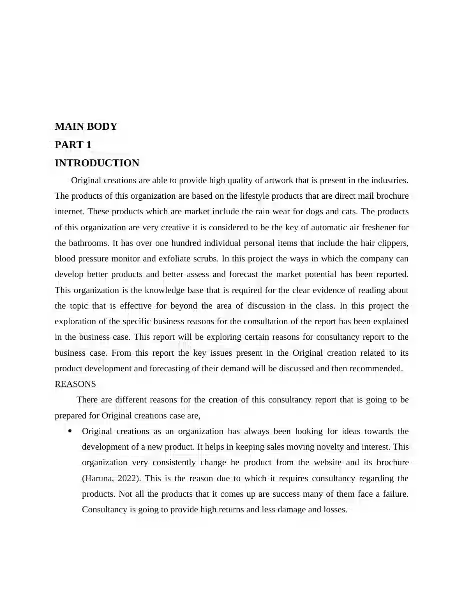
Decoding the Consulting Report Example: A Guide to Structure and Success
Decoding the Consulting Report Example: A Guide to Structure and Success
Many aspiring consultants or business professionals wonder, "What does a successful consulting report actually look like?" This article provides a comprehensive guide to crafting compelling and impactful consulting reports, using a consulting report example as a framework for understanding best practices. We'll break down the key components, from structure and content to presentation and effective communication.
Understanding the Purpose and Audience of Your Consulting Report
Before diving into the specifics, it's crucial to understand the core purpose of a consulting report. It's essentially a concise yet detailed summary of your findings, analysis, and recommendations, designed to help clients solve a specific problem or achieve a particular goal. Think of it as a bridge connecting your research and insights to actionable steps for the client.
The audience is equally important. You're likely addressing individuals or groups who lack the time or specialized expertise to tackle the problem themselves. This means clarity, conciseness, and visual appeal are paramount. A dense, academic-style report will likely be ineffective.
Structuring Your Consulting Report: A Step-by-Step Approach
A well-structured report is critical for clear communication. While the specifics will vary depending on the project and industry (marketing, finance, operations, etc.), a common framework includes:
Cover Page: Includes the report title, client name, date, and your contact information.
Executive Summary: A concise overview of the key findings and recommendations (written last!).
Background: Sets the stage, outlining the problem, your methodology, and key assumptions.
Key Facts/Data: Presents crucial quantitative data using charts and graphs for maximum impact.
Findings: The core of your report, presenting your analysis and insights.
Recommendations: Clear, actionable steps for the client, framed for immediate implementation.
Appendices (Optional): Contains supporting documentation, detailed data, or methodology explanations.
It's often beneficial to start with the Background section to establish context and clearly define the problem you're addressing and the methods used to arrive at your conclusions.
The Importance of the Findings Section
The Findings section is where you showcase your analytical skills. Organize your findings logically, perhaps using the MECE (Mutually Exclusive, Collectively Exhaustive) principle. This ensures that your points are distinct yet comprehensively cover all aspects of the problem. Decision tree diagrams can be particularly useful in achieving this structure. Remember to support your findings with robust evidence and clearly explain your reasoning.
Crafting Compelling Recommendations
Your recommendations should be concrete, concise, and actionable. Instead of vague suggestions, frame them clearly: "To improve customer retention, we recommend implementing a personalized email marketing campaign, because data shows a direct correlation between personalized communication and increased customer loyalty." Focus on tangible, measurable outcomes.
Mastering the Art of Presentation: Communicating Your Findings Effectively
A strong presentation complements the written report, bringing your findings to life. Remember, your presentation shouldn’t just deliver information; it needs to persuade.
Structuring Your Presentation: From "As-Is" to "To-Be"
Begin by establishing the client's current situation (the "as-is" state) and clearly articulate their desired future state (the "to-be" state). This sets the context and clearly demonstrates the value proposition of your recommendations. Visual aids, like before-and-after scenarios, are powerful tools here.
Demonstrating Value and Explaining Your Strategy
Always demonstrate the impact of your recommendations. Use scenario modeling to show the potential benefits, comparing different options and quantifying improvements. Clearly explain your chosen methodology, frameworks, and tools, building credibility and transparency. This shows the client you have a strategic approach, not just a collection of suggestions.
Ending with a Compelling Close
Conclude your presentation with a strong closing slide summarizing the positive outcomes expected if the client implements your recommendations. Leave the client feeling confident and empowered to act on your insights.
Essential Elements of a Winning Consulting Report Example
Several crucial details often get overlooked. For example, the Background section should include a thorough description of the project scope, the client's specific needs, initial assumptions, any excluded data, involved parties, your team's credentials, and the research methods employed. This level of detail provides transparency and builds trust.
Remember to leverage data visualization techniques (charts, graphs) extensively to present key data points and correlations effectively. Effective communication, blending analytical rigor with persuasive presentation skills, is the key to creating a truly impactful consulting report example and delivering successful client engagements. The payoff is significant: consulting offers a rewarding career path, with the direct satisfaction of seeing your work influence client success.
What is a consulting report example?
A consulting report example is a document showcasing the findings and recommendations from a consulting project. It's a high-level summary, detailing the research methodology, and suggesting actionable steps for the client to address a specific problem. The structure and content will vary depending on the industry (e.g., marketing, finance) and the specific problem being addressed. A typical example might include sections on background, key facts, findings, recommendations, and an executive summary.
What is the purpose of a consulting report?
The main purpose is to communicate the results of a consulting engagement to the client organization. This often involves an audience who may lack the time or expertise to fully understand the complexities of the issue. The report provides a clear, concise, and actionable path forward based on research and analysis.
What are the key sections of a consulting report?
While the exact sections can vary, a common structure includes: a cover page, executive summary, background information (including project scope, methodology, and limitations), key facts presented with data visualization, findings (often organized using a MECE framework), recommendations (clear, concise, and actionable), and appendices for supporting data. The executive summary is typically written last, providing a concise overview of the entire report.
How should I structure the findings section of my report?
The findings section is the core of your report. It should present the solutions and justify the research. Organizing your findings using the Mutually Exclusive, Collectively Exhaustive (MECE) framework ensures logical structure, preventing overlaps and gaps in your analysis. Decision trees can be helpful tools to ensure your findings are MECE.
How should I write effective recommendations?
Recommendations should be concrete and actionable "next steps" for the client. Use clear, concise phrasing, such as: "To help with X, we recommend Y, because of Z." Frame each recommendation to highlight its benefit and justify its inclusion.
How can I make my consulting report more impactful?
Use data visualization (charts, graphs) to highlight key data points and correlations effectively. In your presentation, begin by clearly articulating the client's current situation ("as-is") and their desired future state ("to-be"). Show the impact of your recommendations by modeling scenarios (before/after, alternatives) and explain the strategy behind your chosen methodology and tools. A compelling close highlighting positive outcomes will leave a lasting impression.
Why is effective communication crucial in consulting reports?
Effective communication encompasses both strong analytical skills and persuasive presentation skills. A well-written and well-presented report directly influences the client's understanding and adoption of your recommendations, ultimately impacting their success and your own professional standing. Mastering both written and oral communication is key to a rewarding career in consulting.