Consultant Report Example: Crafting a Persuasive Report That Gets Results
Consultant Report Example: Crafting a Persuasive Report That Gets Results
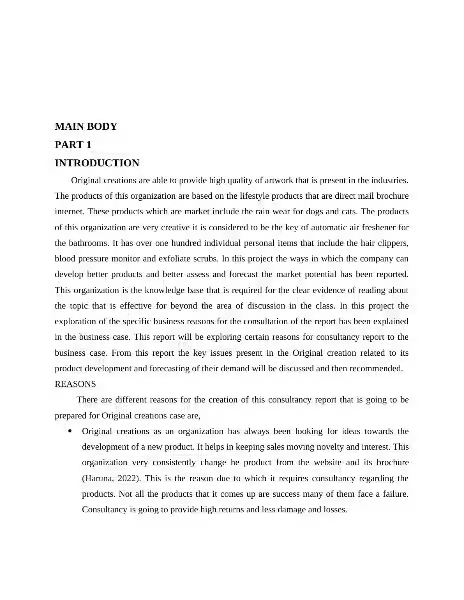
Many aspiring consultants wonder, "How do I write a compelling consultant report that will actually influence my clients?" This question is at the heart of successful consulting, as a well-structured and persuasive report is the culmination of your research and expertise. This article provides a practical guide, using a consultant report example to illustrate key principles and best practices.
Understanding the Structure of a Consultant Report
A consultant report isn't just a collection of data; it's a narrative that persuades a client to take action. It needs to be clear, concise, and compelling, regardless of its length. While academic reports might offer a more expansive format, business-oriented consultant report examples from firms like McKinsey and BCG prioritize brevity and impact.
The structure can be adapted to different project scopes but generally follows a logical flow:
Background: Set the stage by clearly defining the project's scope, the client's goals, your initial assumptions (and limitations), any excluded data, the team involved, and the research methodology used. This section ensures transparency and establishes credibility.
Executive Summary: This is arguably the most crucial section. Written last, it employs a "BLUF" (Bottom Line Up Front) approach, concisely summarizing the key findings and recommendations. It should grab the reader's attention and leave them wanting to learn more. Consider this your elevator pitch for the entire report.
Key Findings: This is the core of your report. Present your data in a clear and logical way, ideally using visualizations such as charts and graphs. Employ the MECE (Mutually Exclusive, Collectively Exhaustive) principle to ensure your analysis is thorough and avoids overlap. This means all categories should be distinct, and together they should cover the entire issue.
Recommendations: Based on your findings, clearly articulate actionable steps the client should take. Frame your recommendations concisely, specifying the problem, the proposed solution, and the rationale behind it ("To address declining sales, we recommend launching a targeted marketing campaign focusing on social media, given the demographic shift towards digital engagement").
Appendices (Optional): This section includes supplementary materials like detailed data tables, interview transcripts, or complex calculations that support your findings but might be too detailed for the main body.
A consultant report example showcasing this structure effectively will typically emphasize clear headings, bullet points, and visual aids to enhance readability and comprehension.
Crafting a Compelling Narrative: The “As-Is” and “To-Be” Approach
A successful consultant report example does more than just present data; it tells a story. This story often centers on the "as-is" and "to-be" states.
The "As-Is" State: Defining the Problem
Begin by clearly articulating the current situation. What challenges is the client facing? What are the root causes of their problems? Use data and evidence to support your claims. This section lays the foundation for justifying the need for change. The more compelling and clear you are about the current problems, the more receptive your client will be to your proposed solutions.
The "To-Be" State: Presenting the Solution
This section showcases how your recommendations will improve the client's situation. Use visual aids (e.g., before-and-after scenarios, projected growth charts) to illustrate the potential positive outcomes. Consider presenting multiple scenarios to highlight the value proposition of your suggested course of action. A clear "to-be" state paints a vivid picture of a better future for the client, making your recommendations more attractive.
The Importance of Methodology and Transparency in a Consultant Report Example
Transparency builds trust. Your report should clearly explain the methodology used to gather and analyze your data. This includes specifying the frameworks, tools, and techniques employed. This demonstrates your professionalism and allows the client to understand the rationale behind your findings and recommendations. Any limitations of your methodology should also be openly acknowledged.
Presenting Your Consultant Report: Persuasion Through Data and Narrative
The presentation of your report is as crucial as its content. Remember, you are not just delivering information; you are persuading the client to act on your recommendations.
Start with the "Why": Begin by re-emphasizing the problem and the urgency of the situation.
Focus on the Value Proposition: Highlight the tangible benefits of adopting your recommendations. Show, don't just tell.
Use Visual Aids Effectively: Charts, graphs, and other visual representations make complex data easier to understand and more memorable.
Handle Questions Confidently: Be prepared to answer questions about your methodology, findings, and recommendations.
End with a Strong Call to Action: Reiterate the positive outcomes of implementing your proposed solutions and clearly outline the next steps.
A good consultant report example will seamlessly integrate these presentation strategies, ensuring your message resonates with the client.
Conclusion: The Power of a Well-Crafted Consultant Report
Crafting a successful consultant report requires a blend of analytical rigor, clear communication, and persuasive storytelling. By following the structure outlined above and focusing on the "as-is" and "to-be" states, you can create a document that not only informs but also persuades. Remember that your report is your final product - a culmination of your expertise and a testament to your ability to solve problems. This consultant report example serves as a guide, but remember to adapt these principles to the specifics of each project and client. The ultimate goal is to deliver a compelling narrative that drives action and delivers value.
A consultant report summarizes findings and recommendations for a client, providing context, methodology, and a proposed course of action. It aims to persuade the client to adopt the recommendations presented. The report often culminates in a presentation to the client. Examples from firms like McKinsey and BCG showcase varying approaches, all emphasizing a clear narrative structure, even in concise formats.
What is the typical structure of a consultant report?
A typical consultant report follows this structure:
Background: Project scope, client, initial assumptions, excluded data, participants, authorship, and research methods.
Executive Summary: A concise overview of key findings and recommendations (written last).
Findings: The core of the report, logically organized using the MECE (Mutually Exclusive, Collectively Exhaustive) principle for clarity and completeness.
Recommendations: Concrete, actionable steps, clearly and concisely framed (e.g., "To address X, we recommend Y, due to Z").
The findings section should utilize the MECE (Mutually Exclusive, Collectively Exhaustive) principle. This ensures that all aspects of the problem are addressed without overlap or omission. Each point should be distinct and all points together should encompass the entire problem.
What makes a strong recommendation?
A strong recommendation is concrete, actionable, and clearly justified. It should follow a clear format like: "To address X (problem), we recommend Y (solution), due to Z (reasoning)." The "Z" component is crucial for building credibility and demonstrating the rationale behind the proposed solution.
How is the executive summary written?
The executive summary is written last. It uses a BLUF (Bottom Line Up Front) approach, immediately stating the key findings and recommendations. It summarizes the entire report concisely, providing the reader with a quick overview of the key takeaways.
How should the consultant report be presented?
The presentation should clearly articulate the "as-is" (current state) and "to-be" (desired state) of the client's situation. It should justify the need for action, present supporting data, and model different scenarios (e.g., before/after comparisons, alternative paths) to demonstrate the value of the recommendations. The methodology used should be transparent to build trust.
What is the overall goal of the consultant report and presentation?
The overall goal is to present a compelling case that persuades the client to act on the recommendations. This requires clear communication, strong evidence, and a well-structured presentation that highlights the positive outcomes of adopting the proposed solutions.