Understanding Tetraethyl Orthosilicate: Applications and Properties
Understanding Tetraethyl Orthosilicate: Applications and Properties
Tetraethyl orthosilicate (TEOS), also known as tetraethoxysilane, is a fascinating chemical compound with a surprisingly wide range of applications. Its versatility stems from its unique chemical structure and its ability to undergo controlled hydrolysis and condensation reactions, making it a crucial building block in various materials science and engineering processes. This article delves into the properties, synthesis, and diverse applications of this important chemical.
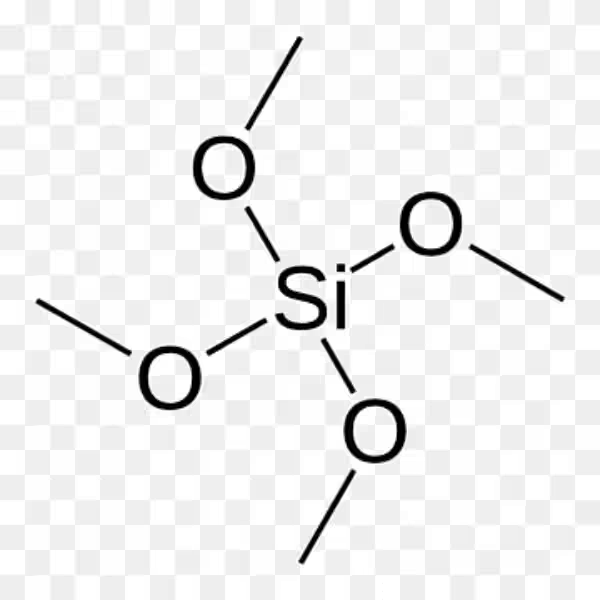
TEOS is a colorless liquid with the chemical formula Si(OC₂H₅)₄. This formula reveals its essential nature: a silicon atom (Si) bonded to four ethoxy groups (-OC₂H₅). This tetrahedral structure is key to its reactivity.
The synthesis of TEOS typically involves the alcoholysis of silicon tetrachloride (SiCl₄) with ethanol (C₂H₅OH). This reaction, often catalyzed by an acid or base, produces TEOS and hydrogen chloride (HCl) as a byproduct. The HCl must be carefully managed and removed from the reaction mixture. The reaction can be represented as follows:
SiCl₄ + 4C₂H₅OH → Si(OC₂H₅)₄ + 4HCl
The purity of the resulting TEOS is crucial for many applications, and therefore, rigorous purification techniques are often employed after synthesis. Reagent-grade TEOS, with a purity exceeding 98%, is essential for demanding applications like semiconductor manufacturing.
Hydrolysis and Condensation: The Key Reactions
The most significant reactions of TEOS are hydrolysis and condensation. Hydrolysis involves the reaction of TEOS with water, breaking the Si-O-C bonds and forming silanol groups (-SiOH). These silanol groups then undergo condensation reactions, forming siloxane bridges (-Si-O-Si-) and releasing ethanol as a byproduct.
These reactions can be controlled by adjusting parameters such as pH, temperature, and water content. Acidic conditions generally lead to faster hydrolysis, while basic conditions can promote condensation. This allows for precise control over the resulting silica structure, leading to materials with different porosities, morphologies, and properties.
The ability to control the hydrolysis and condensation of TEOS makes it a versatile precursor for a wide range of materials. Its applications span multiple industries and scientific disciplines.
Semiconductor Industry and Sol-Gel Processes
One of the most impactful uses of TEOS is in the semiconductor industry. The controlled hydrolysis of TEOS serves as a crucial step in fabricating silicon dioxide (SiO₂) layers used as insulators and dielectrics in integrated circuits. The precision and control offered by these processes are essential for the miniaturization and performance of modern electronics. The Stöber process, a specific sol-gel method, utilizes controlled hydrolysis of TEOS to produce monodisperse silica nanoparticles.
Other Material Science Applications
Beyond semiconductors, TEOS finds applications in:
Sol-gel synthesis of silica-based materials: This encompasses a vast array of materials, including aerogels (extremely low-density materials used for insulation and catalysis), xerogels (porous solids with various applications), and mesoporous silica (materials with uniform pores used in catalysis and separation).
Coatings: TEOS-derived coatings enhance the durability, water resistance, and temperature resistance of various substrates, including metals, glass, and wood.
Binders and adhesives: TEOS can act as an inorganic binder, reinforcing materials and improving adhesion between different components.
Bioactive glasses: TEOS is a key ingredient in the synthesis of bioactive glasses, used in biomedical applications like bone grafts and drug delivery systems. The controlled reaction allows for the incorporation of other metallic elements, tailoring the properties for specific biological interactions.
Zeolites: TEOS contributes to the synthesis of zeolites, porous crystalline aluminosilicates used extensively in catalysis and separation processes.
Safety Considerations
While TEOS is a valuable chemical, it's essential to handle it with care. Inhalation of TEOS vapor can irritate the eyes and respiratory system, and high exposure can lead to more severe effects, including pulmonary edema. Appropriate safety measures, including proper ventilation, respiratory protection, and eye protection, are crucial when working with TEOS. The severity of these hazards is influenced by environmental factors such as high humidity and vapor pressure.
Tetraethyl orthosilicate (TEOS) stands as a testament to the power of controlled chemical reactions in shaping material properties. From the intricate layers of microchips to the porous structures of aerogels and the biocompatible surfaces of bioactive glasses, TEOS’s versatile reactivity and unique chemical structure continue to drive innovation across various fields. However, its potential health risks underscore the importance of safe handling and responsible use in all applications.
Tetraethyl Orthosilicate (TEOS) FAQ
What is Tetraethyl Orthosilicate (TEOS)?
Tetraethyl orthosilicate (TEOS), also known as tetraethoxysilane, is a colorless liquid with the chemical formula Si(OC₂H₅)₄. It's the ethyl ester of orthosilicic acid and the most common silicon alkoxide. It possesses a tetrahedral molecular structure and is synthesized via the alcoholysis of silicon tetrachloride with ethanol, producing TEOS and hydrogen chloride as byproducts.
What are the primary applications of TEOS?
TEOS's primary applications stem from its reactivity, specifically its hydrolysis and condensation reactions. Its most significant uses include:
Precursor to Silicon Dioxide (SiO₂): TEOS readily converts to SiO₂ through hydrolysis with water, crucial in semiconductor manufacturing and sol-gel processes for creating various silica-based materials.
Crosslinking Agent: It acts as a crosslinking agent in silicone polymers.
Silica Source in Diverse Applications: TEOS serves as a silica source in zeolite synthesis, aerogel production, and various coatings.
Additive in Rocket Fuels (Historically): It was used to reduce heat transfer in alcohol-based rocket fuels.
Inorganic Binder and Stiffener: It's used as an inorganic binder and stiffener in steel casting, creating silica-based ceramic molds.
Protective Coatings: TEOS provides protective coatings for materials like steel, glass, brass, and wood, enhancing their resistance to water, oxygen, and high temperatures.
Enhancing Polymer Adhesion: It enhances polymer adhesion to glass, steel, or wood.
Binder in Porcelain Crowns: It serves as a binder in porcelain crowns.
Precursor to Siloxanes: It's a precursor to siloxanes.
TEOS undergoes hydrolysis and condensation reactions. Hydrolysis involves the reaction with water, breaking the Si-O-C bonds and forming Si-OH (silanol) groups. Condensation then occurs, where silanol groups react to form Si-O-Si (siloxane) bonds, leading to the formation of a silica network. The rate of these reactions is influenced by catalysts like acids or bases. Controlled hydrolysis, as in the Stöber process, allows for the creation of specific silica structures. At higher temperatures (>600°C), TEOS decomposes to SiO₂ and diethyl ether.
What are the safety concerns associated with TEOS?
TEOS is irritating to the eyes and respiratory system upon inhalation. High exposure can lead to pulmonary edema. The severity of these hazards is influenced by environmental factors such as humidity and vapor pressure. Proper ventilation and personal protective equipment are crucial when handling TEOS.
What are the unique properties of TEOS that make it useful?
TEOS's versatility arises from its readily controlled reactivity, allowing for the creation of diverse silica-based materials with tailored properties. Its ability to undergo hydrolysis and condensation reactions, coupled with the influence of catalysts and reaction conditions, enables precise control over the final product's structure and characteristics (e.g., porosity, particle size).
Is TEOS environmentally friendly?
While TEOS itself isn't inherently toxic in small amounts, its hydrolysis products (ethanol and silica) are relatively benign. However, proper handling and disposal are essential to minimize environmental impact. Large-scale industrial use requires careful consideration of waste management to prevent any potential pollution.