Understanding Lost Time Injury: A Crucial Safety Metric
Understanding Lost Time Injury: A Crucial Safety Metric
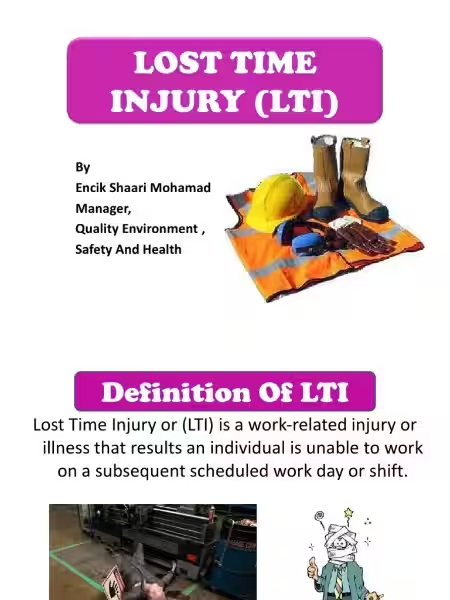
Lost time injury (LTI) is a critical term in workplace safety. It represents a workplace injury serious enough to prevent an employee from performing their regular job duties, resulting in a loss of productive work time. Understanding LTIs is crucial for businesses aiming to maintain a safe work environment and minimize their impact on productivity and financial well-being. This article will explore what constitutes a lost time injury, how it's measured, and its broader implications for workplace safety.
A lost time injury isn't simply a minor scrape or bruise. It encompasses injuries that require an employee to take time off work for medical treatment, recuperation or rehabilitation. This could range from a few days to several months, or even result in permanent disability precluding a return to work. The key factor is the inability to perform regular job duties as a direct result of a work-related incident.
It's important to note that the definition excludes injuries sustained outside of work hours, even if they impact the employee's ability to work. The focus remains on injuries directly linked to the work environment and the tasks performed within it. This distinction is crucial for accurate data collection and analysis.
Measuring Lost Time Injuries: The LTIR
The most common metric used to quantify lost time injuries is the Lost Time Injury Rate (LTIR), also called the Lost Time Incident Rate or Lost Time Case. The LTIR is calculated using a straightforward formula:
(Total number of lost time injuries / Total number of hours worked) x 200,000
This formula provides the number of lost time injuries per 100 workers, assuming a standard working year of 2000 hours per employee. Some organizations prefer using a multiplier of 1,000,000 instead, particularly when the number of LTIs is relatively low compared to total hours worked. This adjustment enhances clarity and ease of interpretation.
The LTIR calculation focuses solely on the number of lost time injuries, not their severity or duration. While the LTIR provides a valuable snapshot of a company's safety performance, it's crucial to acknowledge its limitations.
The LTIR acts as a lagging indicator, meaning it reflects past incidents rather than predicting future performance. A high LTIR is a clear sign of poor safety practices, potentially leading to increased insurance premiums, higher employee turnover (as workers seek safer employment), and reputational damage. However, it doesn't offer insight into the root causes of these incidents.
Moreover, relying solely on the LTIR might overshadow the importance of proactive safety measures. A low LTIR doesn't automatically equate to a robust safety program; it simply indicates that fewer serious injuries have occurred. A comprehensive safety program should aim to prevent injuries altogether, not just react to them.
Beyond the Numbers: Proactive Safety Measures
While the LTIR is a valuable tool for tracking safety performance, it shouldn't be the sole focus. A truly effective safety program emphasizes proactive measures to prevent injuries before they happen. This involves:
Hazard identification and risk assessment: Regularly identifying potential hazards and assessing their risks is a cornerstone of a proactive approach.
Employee training and education: Equipping employees with the knowledge and skills to work safely is paramount. This includes training on safe work practices, the use of personal protective equipment (PPE), and emergency procedures.
Regular safety audits and inspections: Conducting regular inspections helps identify potential hazards before they lead to accidents.
Investigating incidents thoroughly: When incidents do occur, thorough investigation can help identify root causes and implement corrective measures.
Promoting a safety culture: Creating a workplace culture where safety is a top priority is essential for long-term success. This involves open communication, employee participation and management commitment.
OSHA's Role in Lost Time Injury Reporting
The Occupational Safety and Health Administration (OSHA) mandates the recording of work-related injuries and illnesses. While most significant injuries, meeting criteria like days away from work, restricted work, or medical treatment beyond first aid, are easily categorized, OSHA recognizes the need for a more nuanced approach. Some injuries, while not immediately exhibiting these clear indicators, still require recording, particularly if diagnosed by a licensed healthcare professional. This underscores that the immediacy of symptoms shouldn't be the sole factor in determining the recordability of a lost time injury.
The Importance of Accurate Recording of Lost Time Injuries
Accurate recording of LTIs is critical, not only for compliance with OSHA regulations but also for identifying trends, patterns, and areas needing improvement within the workplace. By meticulously documenting each lost time injury, companies can build a comprehensive safety record that provides valuable data for informed decision-making. This data can guide the development and refinement of safety programs, ultimately leading to a reduction in LTIs and a safer work environment. The ultimate goal isn't just a low LTIR; it's a commitment to creating a workplace where injuries are prevented, and employee well-being is prioritized.
A Lost Time Injury (LTI), also known as a lost time incident or lost time case, is a workplace injury that results in an employee's absence from work. This includes temporary absences and permanent disabilities that prevent the employee from performing their regular job duties. Accidents occurring outside of work hours are not included.
How is the Lost Time Injury Rate (LTIR) calculated?
The LTIR is calculated using the following formula: (Total number of lost time injuries / Total number of hours worked) x 200,000. This gives the number of LTIs per 100 workers, assuming a standard of 2,000 hours worked per worker annually. Some organizations use a multiplier of 1,000,000 instead. The calculation considers only the number of lost-time injuries, not their severity or duration.
What does a high LTIR indicate?
A high LTIR indicates poor safety performance within a company. This can lead to increased workers' compensation insurance premiums, higher employee turnover (as employees seek safer workplaces), and negative publicity. While the absolute value is relative and should be compared to industry averages, a consistently high rate signals a serious need for improved safety measures.
Is the LTIR a leading or lagging indicator?
The LTIR is a lagging indicator. This means it reflects past incidents and doesn't predict future safety performance. It's a valuable tool for assessing past performance and identifying areas for improvement but doesn't offer predictive capabilities.
What is the difference between LTIR and other safety metrics like the DART rate?
The LTIR focuses specifically on injuries resulting in time away from work. OSHA's DART (Days Away, Restricted, or Transferred) rate is broader, including incidents resulting in days away from work, restricted work, or job transfer, even without time completely away from work. The LTIR is a subset of the broader picture captured by the DART rate.
Does the LTIR calculation consider the severity of the injury?
No. The LTIR calculation only considers the number of lost-time injuries. The severity and duration of each injury are typically tracked separately using other metrics like the Injury Severity Rate.
How can a company reduce its LTIR?
Reducing the LTIR requires a proactive and comprehensive approach to safety. This includes implementing robust safety programs, providing thorough employee training (including PPE training), regularly assessing and mitigating workplace hazards, and fostering a strong safety culture that prioritizes injury prevention over simply reacting to incidents. Focusing solely on the metric itself, without addressing underlying causes, is unlikely to lead to sustained improvement.
What are some examples of injuries that would be classified as LTIs?
Any workplace injury resulting in an employee's absence from work, regardless of duration, would be classified as an LTI. Examples include fractures, sprains, strains, burns, cuts requiring more than first aid, and illnesses directly caused by the workplace environment. Even injuries that initially seem minor but later require time off work are included.
Are there specific injuries that OSHA mandates be recorded immediately, even without initial time off?
Yes. OSHA mandates immediate recording for certain injuries at the time of diagnosis by a licensed healthcare professional, even if the employee doesn't initially miss work or require restricted duties. These include cancer diagnoses, chronic irreversible diseases, fractured or cracked bones, and punctured eardrums, amongst others. This is because the long-term consequences of these injuries may not be immediately apparent.
Why is it important to focus on preventing LTIs rather than just tracking them?
While tracking LTIs provides valuable data, preventing them is paramount. A safe work environment is the ultimate goal. A proactive approach to safety, emphasizing prevention through robust programs and a strong safety culture, is far more effective than simply reacting to incidents reflected in the LTIR. Prevention leads to better overall safety outcomes and a lower LTIR.