What is Propanal? Understanding This Versatile Chemical
What is Propanal? Understanding This Versatile Chemical
What exactly is propanal, and why is it so important in various industries and even in the vastness of space? This seemingly simple molecule plays a surprisingly significant role in chemistry, from industrial production to its surprising presence in extraterrestrial environments. Let's delve into the fascinating world of propanal.
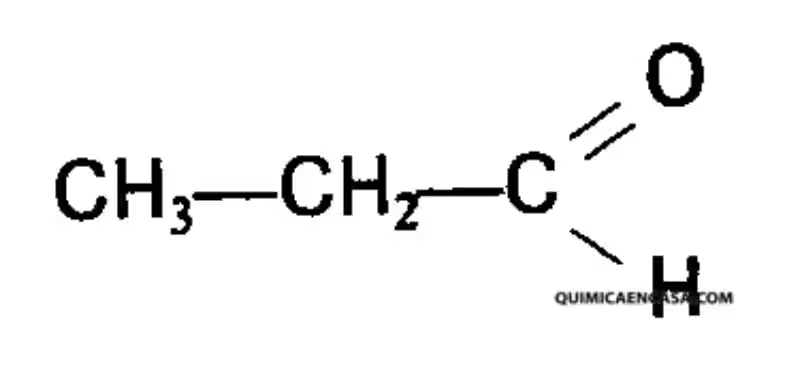
Propanal, also known as propionaldehyde, is a three-carbon aldehyde with the chemical formula CH₃CH₂CHO. It's a colorless, flammable liquid with a distinctive pungent, somewhat fruity odor. This odor is often described as sharp and slightly irritating.
The structure of propanal features a three-carbon chain (a propyl group) with an aldehyde functional group (-CHO) at one end. This aldehyde group is the key to its reactivity and many of its applications. The carbonyl group (C=O) within the aldehyde is highly reactive, participating in a range of chemical reactions.
Industrial Production of Propanal
Propanal is produced industrially on a massive scale, primarily through a process called hydroformylation. This involves reacting ethylene (C₂H₄), carbon monoxide (CO), and hydrogen (H₂) under specific conditions of temperature and pressure, in the presence of a catalyst. This yields hundreds of thousands of tons of propanal annually, highlighting its importance as a chemical building block.
Another method involves the oxidation of 1-propanol (CH₃CH₂CH₂OH). This laboratory synthesis utilizes a mixture of sulfuric acid and potassium dichromate as an oxidizing agent, but careful temperature control is crucial to prevent over-oxidation to propionic acid (CH₃CH₂COOH). The oxidation of 1-propanol to propanal, therefore, requires careful optimization.
Chemical Reactions and Reactivity of Propanal
Propanal, like other aldehydes, exhibits a range of reactions. Its reactivity is largely due to the presence of the carbonyl group, which is susceptible to both oxidation and reduction.
Oxidation: Propanal readily oxidizes to propionic acid, a useful preservative. This is a characteristic reaction that distinguishes aldehydes from ketones.
Reduction: Reduction of propanal yields 1-propanol, a common solvent and intermediate in organic synthesis.
Aldol Condensation: Propanal participates in aldol condensation reactions, forming larger molecules through self-reaction or reactions with other aldehydes or ketones. This is followed by dehydration and hydrogenation to create products like 2-methylpentanal.
Other Reactions: Propanal can also undergo reactions such as nucleophilic addition and amination. For instance, reactions with amines lead to imines, and others with Grignard reagents yield secondary alcohols after hydrolysis.
The presence of a prochiral methylene group (–CH₂–) adjacent to the carbonyl group is a notable characteristic. This allows for the creation of chiral α-functionalized derivatives, meaning that substituting a hydrogen atom on this methylene group can lead to molecules with different optical activity. This feature is important in the creation of specialized chemicals. Propanal also forms an equilibrium with 1,1-propanediol in the presence of water.
Applications of Propanal: From Resins to Fragrances
The versatility of propanal is reflected in its wide range of applications. Its importance lies in its role as a chemical building block for the synthesis of many other valuable compounds.
Industrial Applications
Alkyd Resins: Propanal is a key precursor to trimethylolethane, a crucial intermediate in the production of alkyd resins, widely used in paints and coatings. This reaction involves a condensation process with formaldehyde.
Aroma Compounds: It serves as a building block for various aroma chemicals, including cyclamen aldehyde, helional, and lilial, used in perfumes and flavorings. These compounds mimic natural scents and flavors, enhancing the appeal of various products.
Solvents and Intermediates: Propanal's increasing use as a solvent is linked to the growing demand for non-chlorocarbon alternatives. It's used in processes like the bromination of n-propanol to produce propyl bromide.
Production of other chemicals: Propanal is a crucial intermediate in the synthesis of n-propanol (via reduction), propanamine (via reductive amination), and propionic acid and propionates (via oxidation). Propionates find use as food preservatives.
The versatility of propanal makes it a key player in chemical industries. Its diverse applications underline its importance as a readily available and reactive building block.
Propanal in the Cosmos and Safety Considerations
Surprisingly, propanal isn't confined to Earth. It has been detected in extraterrestrial environments, including the Sagittarius B2 molecular cloud in the Milky Way galaxy and on the surface of comet 67P/Churyumov–Gerasimenko. This highlights its presence in the broader cosmos.
Safety Precautions
While propanal's acute toxicity is relatively low (LD50 of 1690 mg/kg orally), it's still an irritant to the lungs and eyes. Its flammability also poses a fire hazard. Therefore, appropriate safety precautions, including adequate ventilation and personal protective equipment, are crucial when handling propanal.
In conclusion, what is propanal? It is a versatile and reactive chemical with a wide range of applications, from industrial production to its surprising presence in space. Understanding its properties and reactivity is crucial in various fields, from organic chemistry to materials science and beyond.
Frequently Asked Questions about Propanal
What is propanal?
Propanal, also known as propionaldehyde, is a three-carbon aldehyde with the chemical formula CH₃CH₂CHO. It's a colorless, flammable liquid with a pungent, fruity odor. Its chemical properties are largely determined by its aldehyde functional group (-CHO).
How is propanal produced?
Propanal is produced industrially on a large scale primarily through the hydroformylation of ethylene (ethylene + carbon monoxide + hydrogen → propionaldehyde). This process yields hundreds of thousands of tons annually. It can also be synthesized in the laboratory by carefully oxidizing 1-propanol using a mixture of sulfuric acid and potassium dichromate, requiring precise temperature control to avoid over-oxidation to propionic acid.
Propanal behaves similarly to other alkyl aldehydes. It readily undergoes reactions such as hydrogenation (reduction), aldol condensations, and oxidation. A key characteristic is its prochiral methylene group, which allows for the formation of chiral α-functionalized derivatives. It also forms an equilibrium with 1,1-propanediol in the presence of water. For example, it can undergo aldol condensation, followed by dehydration and hydrogenation, to produce 2-methylpentanal.
What are the main applications of propanal?
Propanal serves as a versatile chemical building block. Industrially, it's a crucial precursor to trimethylolethane, an intermediate in alkyd resin production (formed via condensation with formaldehyde). It's also a building block for various aroma compounds (e.g., cyclamen aldehyde, helional, and lilial). Further reactions allow the production of n-propanol (reduction), propanamine (reductive amination), and propionic acid and propionates (oxidation), the latter used as preservatives. Increasing demand for non-chlorocarbon solvents has also led to its use in the bromination of n-propanol to produce propyl bromide. In the laboratory, it's used in various condensation reactions; for instance, with tert-butylamine to create a three-carbon building block useful in organic synthesis.
Where can propanal be found?
Besides terrestrial applications, propionaldehyde has been detected in extraterrestrial environments, such as the Sagittarius B2 molecular cloud in the Milky Way galaxy and on the surface of comet 67P/Churyumov–Gerasimenko.
Is propanal safe to handle?
While propanal exhibits low acute toxicity (LD50 of 1690 mg/kg orally), it is a lung and eye irritant and presents a fire hazard due to its flammability. Appropriate safety precautions are necessary when handling and using it.