Understanding Potassium Chromate: A Comprehensive Guide
Understanding Potassium Chromate: A Comprehensive Guide
Potassium chromate (K₂CrO₄) is a vibrant yellow inorganic compound, a familiar sight in many chemistry labs. While less prevalent industrially than its sodium counterpart, its unique properties make it an invaluable reagent in specific applications. This article delves into the properties, uses, safety precautions, and synthesis of potassium chromate, aiming to provide a comprehensive understanding of this important chemical.
Potassium chromate exists as a bright yellow crystalline solid. Its structure closely resembles that of potassium sulfate, showcasing the versatility of ionic bonding in forming different crystal lattices. The compound crystallizes in two main forms: the common orthorhombic β-K₂CrO₄ and a higher-temperature α-form, with the transition occurring above 666°C. This structural polymorphism, while interesting from a crystallographic perspective, doesn't significantly alter the chemical reactivity of the compound in most applications.
Despite the variations in overall crystal structure, the chromate ion (CrO₄²⁻) itself maintains a consistent tetrahedral geometry. This tetrahedral arrangement of oxygen atoms around the central chromium atom is crucial to understanding the chromate ion's reactivity and its characteristic yellow color, which is a direct result of the electronic transitions within this structure. This consistent geometry simplifies many of its chemical reactions and makes it relatively predictable in its behavior.
Synthesis of Potassium Chromate
The synthesis of potassium chromate can be achieved through two main methods. The most common involves the reaction of potassium dichromate (K₂Cr₂O₇) with potassium hydroxide (KOH):
K₂Cr₂O₇ + 2KOH → 2K₂CrO₄ + H₂O
This reaction is an example of a redox reaction where the chromium in dichromate is reduced from a +6 oxidation state to a +6 oxidation state (it doesn't change). The addition of potassium hydroxide simply shifts the equilibrium towards the chromate form.
Alternatively, potassium chromate can be synthesized by fusing potassium hydroxide with chromium trioxide (CrO₃):
2KOH + CrO₃ → K₂CrO₄ + H₂O
This method involves a high-temperature reaction, and it's less frequently used due to the potential hazards associated with handling molten alkalis and chromium trioxide. Both methods ultimately yield potassium chromate and water as products.
While sodium chromate dominates industrial applications, potassium chromate finds its niche primarily in laboratory settings. Its anhydrous form is preferred in certain situations where water content needs to be strictly controlled. This dry nature is crucial for applications where water could interfere with the reaction or analysis.
One important application lies in its use as an oxidizing agent in organic synthesis. This highlights a property often overlooked – the strong oxidizing power of the chromate ion. In specific organic reactions, potassium chromate can facilitate oxidation reactions that might be difficult to achieve with other reagents.
In analytical chemistry, potassium chromate is indispensable for qualitative inorganic analysis. It's a well-established colorimetric indicator for silver ions (Ag⁺), and its role in precipitation titrations is critical. For example, in the Mohr method for determining chloride concentration, the addition of potassium chromate to a solution containing chloride ions (Cl⁻) and silver nitrate (AgNO₃) produces a red precipitate of silver chromate (Ag₂CrO₄) once all the chloride is precipitated as silver chloride (AgCl). This distinct color change signifies the endpoint of the titration, allowing for precise determination of chloride concentration. This dual role, acting as both an indicator and a potential titrant, makes potassium chromate very versatile in analytical procedures.
Safety Precautions and Health Hazards
It is crucial to emphasize that potassium chromate, like all hexavalent chromium (Cr(VI)) compounds, poses significant health risks. It's classified as a known carcinogen, meaning it can cause cancer. Direct contact with the eyes can lead to severe irritation and potential blindness due to its corrosive nature. Beyond the immediate dangers, chronic exposure is linked to impaired fertility, heritable genetic damage, and harm to developing fetuses.
Therefore, handling potassium chromate requires strict adherence to safety protocols. These include:
Using appropriate personal protective equipment (PPE): This includes safety glasses, gloves, lab coats, and respiratory protection.
Working in a well-ventilated area: To minimize inhalation of dust particles.
Proper disposal: Following all local regulations for the disposal of hazardous waste.
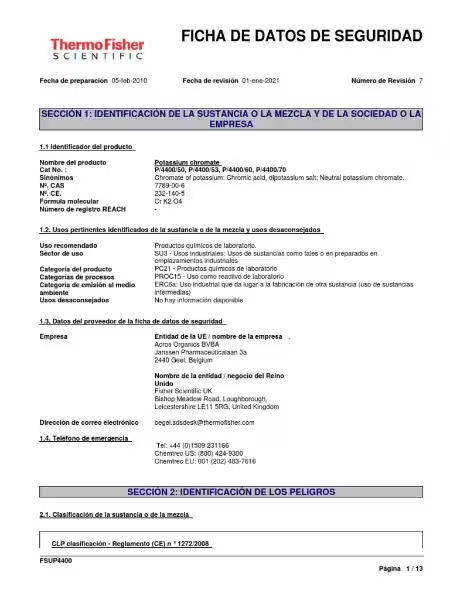
Never underestimate the dangers associated with this substance. Consult the Safety Data Sheet (SDS) before handling potassium chromate.
Potassium chromate, despite its relatively limited industrial use, remains a crucial reagent in laboratory settings. Its unique properties, particularly its anhydrous form and its role as an oxidizing agent and indicator in analytical chemistry, make it an irreplaceable tool for researchers and analytical chemists. However, its hazardous nature demands meticulous attention to safety precautions to minimize the risk of exposure and potential health consequences. Always prioritize safe handling practices and consult relevant safety data sheets before working with this compound. Remember, responsible handling is paramount when working with chromate potassium.
Potassium chromate (K₂CrO₄) is a yellow, inorganic compound—the potassium salt of the chromate anion. While less industrially significant than sodium chromate, it's commonly used in laboratory settings due to its properties as an anhydrous form and an oxidizing agent. It exists in two crystalline forms (orthorhombic β-K₂CrO₄ and a higher-temperature α-form). The chromate ion itself has a tetrahedral geometry.
How is Potassium Chromate Synthesized?
Potassium chromate is typically synthesized through two main methods: the reaction of potassium dichromate with potassium hydroxide, or the fusion of potassium hydroxide and chromium trioxide. Both reactions yield potassium chromate and water as a byproduct.
What are the Key Properties of Potassium Chromate?
Potassium chromate is a yellow crystalline solid. Further physical properties (like melting point, boiling point, and solubility) would require consultation of specialized chemical databases. Its aqueous solutions behave similarly to those of sodium dichromate. A significant reaction is the precipitation of orange-yellow lead(II) chromate when reacted with lead(II) nitrate.
What are the Uses of Potassium Chromate?
Its primary applications are in laboratory settings. It's preferred over sodium chromate when an anhydrous form is needed or when it serves as an oxidizing agent in organic synthesis. In analytical chemistry, it's used as a colorimetric indicator for silver ions and in precipitation titrations with silver nitrate and sodium chloride (where a red color change signals excess silver ions).
What are the Safety Concerns Associated with Potassium Chromate?
Potassium chromate, like other hexavalent chromium (Cr(VI)) compounds, is highly toxic. It's classified as carcinogenic and corrosive, causing severe eye damage (potentially blindness). Exposure is also linked to impaired fertility, heritable genetic damage, and harm to developing fetuses. Strict safety precautions are essential when handling this compound. Specific safety data sheets (SDS) should always be consulted before use.
What are the necessary safety precautions when handling potassium chromate?
Because potassium chromate is highly toxic and corrosive, handling it requires stringent safety measures. These include the use of appropriate personal protective equipment (PPE) such as gloves, eye protection, and lab coats. Work should be conducted in a well-ventilated area or a fume hood to minimize inhalation risks. Proper disposal procedures must be followed according to local regulations. Consult the Safety Data Sheet (SDS) for detailed information.
Where can I find more detailed information on Potassium chromate's properties and safety?
Comprehensive information on potassium chromate's chemical and physical properties, toxicity, safety protocols, and regulatory information can be found in chemical databases and safety data sheets (SDS). Always consult the SDS provided by the supplier before handling this chemical.
What is the significance of the ACS reagent grade and stated purity?
The designation "ACS reagent grade" indicates that the potassium chromate meets the standards set by the American Chemical Society for purity and suitability for analytical and other sensitive laboratory applications. A purity of at least 99.0% ensures minimal interference from impurities in experimental results.
Why is the CAS registry number important?
The CAS registry number (7789-00-6 for potassium chromate) is a unique identifier used globally to ensure unambiguous identification of the chemical. This avoids confusion with other chemicals and is crucial for accurate ordering, referencing and record keeping.
Why is specifying the lot or batch number important?
Even with ACS reagent grade chemicals, slight variations can occur between production batches. Specifying the lot or batch number ensures traceability and allows for verification of the exact properties of the reagent used, which is important for reproducibility in scientific work.



![Understanding K₃[Fe(CN)₆]: Properties, Applications, and Safety of Potassium Ferricyanide](https://laboraprevencion.com/en/wp-content/uploads/k3-fe-cn-6.avif "Understanding K₃[Fe(CN)₆]: Properties, Applications, and Safety of Potassium Ferricyanide")