Understanding Potassium Ferricyanide: Uses, Properties, and Safety
Understanding Potassium Ferricyanide: Uses, Properties, and Safety
Potassium ferricyanide, a vibrant red crystalline compound, holds a significant place in various scientific and industrial applications. Its unique chemical properties, primarily its redox capabilities, make it a versatile reagent in diverse fields, from photography to analytical chemistry. However, understanding its potential hazards is crucial for safe handling.
Chemical Properties and Structure of Potassium Ferricyanide
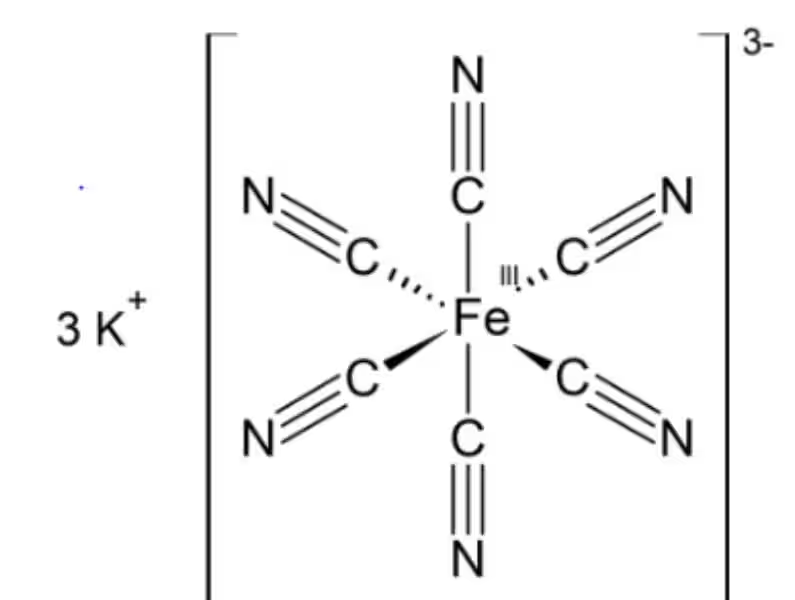
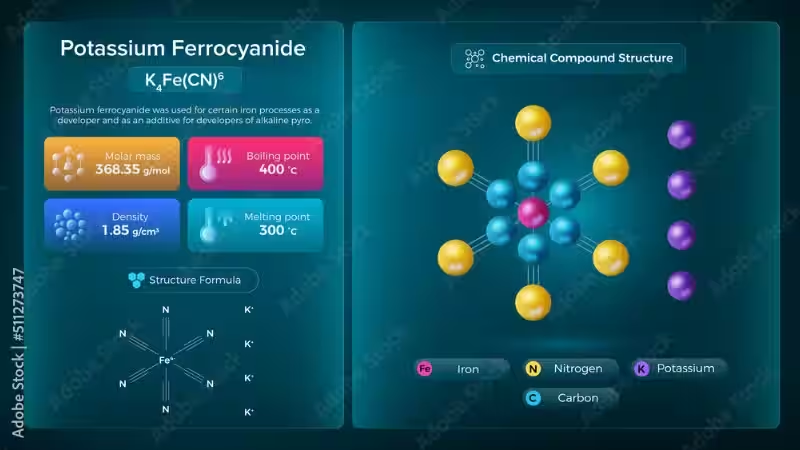
Potassium ferricyanide (K₃[Fe(CN)₆]) is a coordination complex featuring an iron(III) ion (Fe³⁺) centrally coordinated by six cyanide ligands (CN⁻) in an octahedral arrangement. This forms the [Fe(CN)₆]³⁻ anion, balanced by three potassium cations (K⁺). The intense red color stems from ligand-to-metal charge transfer within this complex ion, a fascinating aspect of its coordination chemistry.
Its solid-state structure is more intricate, a polymeric network with [Fe(CN)₆]³⁻ units linked by K⁺ ions. However, these K⁺---NCFe linkages readily break apart when dissolved in water, resulting in a solution containing freely moving [Fe(CN)₆]³⁻ and K⁺ ions. This dissociation is critical for its reactivity in various applications. The solubility in water contributes to its ease of use in many processes.
Industrial Production and Applications of Potassium Ferricyanide
Potassium ferricyanide's industrial production typically involves the chlorination of potassium ferrocyanide, a process reflecting the close relationship between these two compounds:
2 K₄[Fe(CN)₆] + Cl₂ → 2 K₃[Fe(CN)₆] + 2 KCl
This relatively straightforward synthesis underpins its widespread availability. The resulting potassium ferricyanide then finds applications across a spectrum of industries and scientific disciplines.
Photography and Imaging
Potassium ferricyanide plays a crucial role in photography, particularly in cyanotype printing (creating blueprints) and various toning processes. It acts as a mild oxidizing agent, bleaching away silver halide crystals or altering the density of photographic images. It's a vital component of Farmer's reducer, used alongside sodium thiosulfate to fine-tune the density of both negatives and prints. While historically used in color photography bleaching, safer alternatives have largely replaced it due to the potential for hydrogen cyanide (HCN) release under acidic conditions. The compound also finds niche uses in color lithography for dot etching, a form of manual color correction.
In organic chemistry, potassium ferricyanide serves as a mild oxidizing agent, particularly valuable in catalyst regeneration processes in reactions such as Sharpless dihydroxylations. Its ability to facilitate controlled oxidation reactions without harsh conditions makes it a valuable tool in synthetic organic chemistry. This controlled oxidative power makes it less likely to induce unwanted side reactions during complex organic syntheses.
Analytical Chemistry and Reagent Applications
As a reagent, potassium ferricyanide demonstrates its versatility. It’s crucial in preparing ferroxyl indicator solution (with phenolphthalein), which detects Fe²⁺ ions, helpful in identifying rust formation. Its color intensity allows for quantitative analysis of Fe²⁺ using a colorimeter. It also helps determine the ferric reducing power potential of samples—a measure of antioxidant capacity. In physiological experiments, it increases the redox potential of solutions, enabling the oxidation of reduced cytochrome c. Finally, it acts as an electron transfer agent in amperometric biosensors, such as those in commercial blood glucose meters.
Other Applications
Potassium ferricyanide's applications extend beyond these primary areas. In metallurgy, it's a component of Murakami's etchant, used to enhance contrast in cemented carbides. In histology, it's employed to detect ferrous iron (Fe²⁺) in biological tissues, reacting to form Prussian blue (or Turnbull's blue – chemically identical to Prussian blue; note that potassium ferrocyanide is used to detect ferric iron (Fe³⁺)).
Safety Concerns and Handling Precautions
While potassium ferricyanide is considered a relatively low-toxicity compound, a significant safety concern revolves around its potential to release highly toxic hydrogen cyanide (HCN) gas under strongly acidic conditions. This reaction underscores the necessity for careful handling, especially when working with acids.
The reaction with dilute sulfuric acid under heating is particularly dangerous, producing potassium sulfate, ferric sulfate, and HCN. While concentrated sulfuric acid produces different byproducts, avoiding HCN formation, it still presents a hazardous reaction. Appropriate personal protective equipment (PPE), including gloves, eye protection, and a well-ventilated workspace, are mandatory when handling potassium ferricyanide. Always consult the relevant Safety Data Sheet (SDS) before commencing any work involving this compound.
In conclusion, potassium ferricyanide is a valuable reagent with diverse applications. However, its potential to release toxic HCN under specific conditions requires meticulous attention to safety protocols. Understanding its chemical properties and handling it responsibly is paramount to its safe and effective utilization.
Frequently Asked Questions about Potassium Ferricyanide (K₃[Fe(CN)₆])
What is Potassium Ferricyanide?
Potassium ferricyanide, also known as potassium hexacyanoferrate(III), is a bright red, water-soluble salt with the chemical formula K₃[Fe(CN)₆]. It contains the [Fe(CN)₆]³⁻ ion, where an iron(III) ion is surrounded by six cyanide ligands in an octahedral arrangement. While its solid-state structure is complex and polymeric, it dissociates into its constituent ions in water.
Who discovered Potassium Ferricyanide?
Its discovery is credited to Leopold Gmelin in 1822.
How is Potassium Ferricyanide produced industrially?
It's produced by chlorinating a solution of potassium ferrocyanide: 2 K₄[Fe(CN)₆] + Cl₂ → 2 K₃[Fe(CN)₆] + 2 KCl
What are the main applications of Potassium Ferricyanide?
Potassium ferricyanide has diverse applications across various fields:
Photography: Used in cyanotype printing (blueprints), toning processes, and historically in color photography bleaching (though largely replaced by safer alternatives). It acts as a mild bleach and is a component of Farmer's reducer. It also finds use in color lithography.
Organic Chemistry: Acts as a mild oxidizing agent, particularly in catalyst regeneration during Sharpless dihydroxylations.
Analytical Chemistry: Used in creating ferroxyl indicator solution (detecting Fe²⁺), quantitative analysis of Fe²⁺ using colorimetry, determining ferric reducing power (antioxidant capacity), and as an electron transfer agent in biosensors (e.g., blood glucose meters).
Metallurgy: A component of Murakami's etchant, used to enhance contrast in cemented carbides.
Histology: Used to detect ferrous iron (Fe²⁺) in biological tissues, forming Prussian blue.
While generally considered a low-toxicity compound and a mild irritant, potassium ferricyanide poses a significant safety hazard: under strongly acidic conditions, it can release highly toxic hydrogen cyanide (HCN) gas. This reaction is particularly dangerous with dilute sulfuric acid under heating. Therefore, caution is essential, especially when handling it near strong acids. Always consult a Safety Data Sheet (SDS) before handling.
What are the safety precautions when using Potassium Ferricyanide?
Always handle potassium ferricyanide with care. Avoid contact with skin and eyes. Work in a well-ventilated area. Never mix it with strong acids, especially under heating conditions. Wear appropriate personal protective equipment (PPE), including gloves, eye protection, and a lab coat. Consult the SDS for detailed safety information.
What happens when Potassium Ferricyanide reacts with strong acids?
The reaction with strong acids, particularly under heating, can lead to the release of highly toxic hydrogen cyanide (HCN) gas. The specific byproducts vary depending on the acid's concentration and reaction conditions.
What is the color of Potassium Ferricyanide?
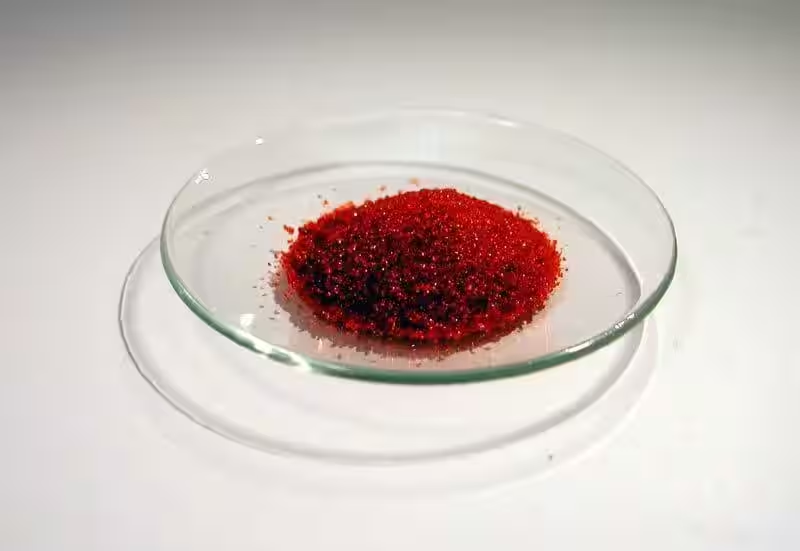
Potassium ferricyanide is a bright red crystalline solid.
What is the role of Potassium Ferricyanide in blueprint creation?
In cyanotype printing, potassium ferricyanide acts as an oxidizing agent, reacting with ferrous salts to produce the insoluble Prussian blue pigment that creates the characteristic blue color of blueprints.
This FAQ provides a general overview. Always consult reliable scientific sources and safety data sheets (SDS) for detailed information before handling potassium ferricyanide or conducting any experiments involving it.


![Understanding K₃[Fe(CN)₆]: Properties, Applications, and Safety of Potassium Ferricyanide](https://laboraprevencion.com/en/wp-content/uploads/k3-fe-cn-6.avif "Understanding K₃[Fe(CN)₆]: Properties, Applications, and Safety of Potassium Ferricyanide")