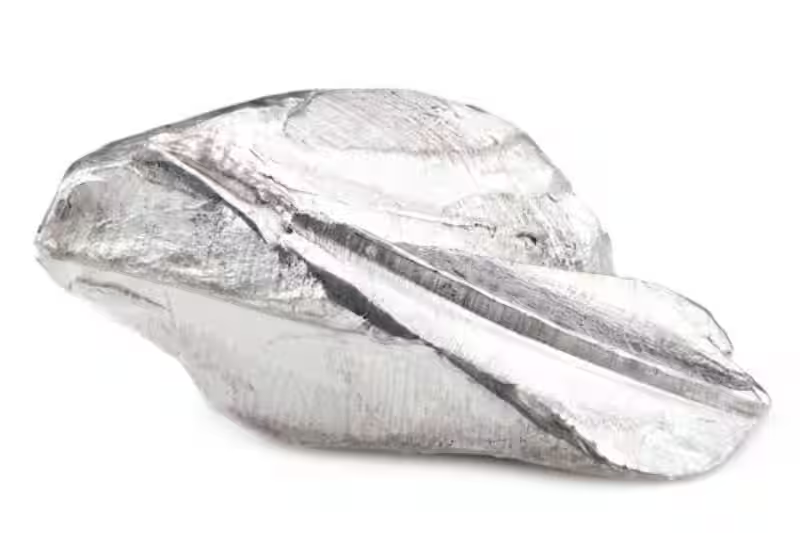
Understanding Dicobalt Octacarbonyl: A Deep Dive into its Chemistry and Applications
Understanding Dicobalt Octacarbonyl: A Deep Dive into its Chemistry and Applications
Dicobalt octacarbonyl (Co₂(CO)₈) is a fascinating organometallic compound that plays a significant role in both organometallic chemistry and organic synthesis. Its unique structure and reactivity make it a versatile reagent and catalyst, involved in a wide range of chemical transformations. This article explores the key aspects of dicobalt octacarbonyl, from its structure and synthesis to its diverse applications and safety considerations.
The Structure and Isomerism of Dicobalt Octacarbonyl
Dicobalt octacarbonyl's structure is more complex than it initially appears. The molecule consists of two cobalt atoms surrounded by eight carbon monoxide (CO) ligands. However, these ligands aren't arranged statically; instead, the molecule exists in several rapidly interconverting isomers.
This isomerization leads to variations in the Co-Co bond length and the overall symmetry of the molecule. The most prominent isomers are: a major isomer featuring two bridging CO ligands and six terminal CO ligands (C₂ᵥ symmetry), and a less abundant isomer with no bridging CO ligands and a direct Co-Co bond, resulting in eight terminal CO ligands (D₄d symmetry). The absence of a direct Co-Co bond in the major isomer is a particularly interesting aspect of its bonding. The dynamic equilibrium between these isomers is important to consider when understanding its reactivity.
Synthesis of Dicobalt Octacarbonyl
Several methods exist for synthesizing dicobalt octacarbonyl. A common approach involves the high-pressure carbonylation of cobalt(II) salts. This process utilizes high pressures of carbon monoxide to react with cobalt salts, leading to the formation of dicobalt octacarbonyl.
Alternatively, heating cobalt metal in a high-pressure atmosphere of carbon monoxide gas can also yield the desired product. A less common route uses cyanide to generate an intermediate complex, which then facilitates the formation of dicobalt octacarbonyl. Each method offers different advantages depending on available resources and desired scale.
Reactivity and Key Reactions of Dicobalt Octacarbonyl
Dicobalt octacarbonyl exhibits a rich reactivity profile, participating in a wide array of reactions. Many of these reactions involve the cleavage of the Co-Co bond or the substitution of CO ligands.
Reduction of dicobalt octacarbonyl with alkali metals leads to the cleavage of the Co-Co bond, producing tetracarbonylcobaltate salts, [Co(CO)₄]⁻. These salts can be further protonated to yield tetracarbonyl cobalt hydride, HCo(CO)₄, a crucial intermediate in several catalytic processes. Electrophiles, such as halogens, also readily cleave the metal-metal bond.
Reactions with Alkynes and Other Substrates
The interaction of dicobalt octacarbonyl with alkynes is particularly significant. This interaction forms the basis of several important reactions, including the Nicholas reaction (alkoxy group substitution on an alkyne) and the Pauson-Khand reaction (cyclization of an alkyne, alkene, and CO to form a cyclopentenone). While Co₂(CO)₈ catalyzes the Pauson-Khand reaction, more efficient catalysts are now often preferred. The complex formed between dicobalt octacarbonyl and alkynes can serve as a protective group for alkynes. The molecule can also catalyze alkyne trimerization.
Furthermore, dicobalt octacarbonyl reacts with nitric oxide (NO) to form cobalt tricarbonyl nitrosyl. It also readily abstracts halides from alkyl halides. Heating dicobalt octacarbonyl leads to decarbonylation and the formation of tetracobalt dodecacarbonyl, Co₄(CO)₁₂, while reaction with bromoform (CHBr₃) produces methylidynetricobaltnonacarbonyl, HCo₃(CO)₉.
Applications of Dicobalt Octacarbonyl
Dicobalt octacarbonyl's importance lies primarily in its catalytic applications. Its most notable role is in hydroformylation, a crucial industrial process for converting alkenes to aldehydes.
Hydroformylation Catalysis
The hydrogenation of dicobalt octacarbonyl produces HCo(CO)₄, the active catalyst in the hydroformylation reaction. This reaction involves the addition of hydrogen and carbon monoxide across a carbon-carbon double bond, resulting in the formation of aldehydes. The selectivity of this process can be tuned by substituting CO ligands with tertiary phosphines. "Hard" Lewis bases can induce disproportionation of dicobalt octacarbonyl.
Handling dicobalt octacarbonyl requires careful attention to safety. It is pyrophoric, meaning it ignites spontaneously in air, and decomposes to release toxic carbon monoxide. Therefore, it is crucial to handle this compound under an inert atmosphere and with appropriate respiratory protection. Strict adherence to occupational exposure limits is mandatory.
Dicobalt octacarbonyl, with its unique structure, isomerism, and diverse reactivity, stands as a cornerstone compound in organometallic chemistry. Its applications in catalysis, particularly hydroformylation, are of significant industrial importance. However, its hazardous nature necessitates stringent safety protocols during handling and use. Further understanding of its reactivity continues to drive innovation in catalysis and organic synthesis.
Dicobalt Octacarbonyl (Co₂(CO)₈) FAQ
What is Dicobalt Octacarbonyl?
Dicobalt octacarbonyl (Co₂(CO)₈) is an organometallic compound of cobalt and carbon monoxide. It's a crucial reagent and catalyst in organometallic chemistry and organic synthesis, particularly known as a precursor for hydroformylation catalysts.
What is the Structure of Dicobalt Octacarbonyl?
The molecule consists of two cobalt atoms linked by eight carbon monoxide (CO) ligands. It exists in multiple rapidly interconverting isomers. The most common are a major isomer with two bridging CO ligands and six terminal CO ligands (C₂ᵥ symmetry), and a minor isomer with no bridging CO ligands and a direct Co-Co bond (D₄d symmetry). The presence or absence of a direct Co-Co bond significantly affects its reactivity.
How is Dicobalt Octacarbonyl Synthesized?
Dicobalt octacarbonyl is typically synthesized through high-pressure carbonylation of cobalt(II) salts or by heating cobalt metal in carbon monoxide gas under high pressure. An alternative method utilizes cyanide to create an intermediate that subsequently forms the octacarbonyl.
What are the Key Reactions of Dicobalt Octacarbonyl?
Dicobalt octacarbonyl undergoes a variety of reactions. Reduction cleaves the Co-Co bond, creating tetracarbonylcobaltate salts. Electrophiles, like halogens, also cleave this bond. Reaction with nitric oxide produces cobalt tricarbonyl nitrosyl. Its reactivity with alkynes is particularly important, featuring in the Nicholas and Pauson-Khand reactions. It also abstracts halides from alkyl halides. Heating causes decarbonylation to form tetracobalt dodecacarbonyl. Reaction with bromoform yields methylidynetricobaltnonacarbonyl.
What is the Role of Dicobalt Octacarbonyl in the Pauson-Khand Reaction?
Dicobalt octacarbonyl catalyzes the Pauson-Khand reaction, a [2+2+1] cycloaddition forming cyclopentenones from alkynes, alkenes, and carbon monoxide. While it catalyzes this reaction, more efficient methods are now available. The complex formed between Co₂(CO)₈ and alkynes also acts as a useful alkyne protecting group.
How is Dicobalt Octacarbonyl used in Hydroformylation?
Hydroformylation, converting alkenes to aldehydes, is another key application. Hydrogenation of Co₂(CO)₈ produces cobalt tetracarbonyl hydride, HCo(CO)₄, the active catalyst. Substituting CO ligands with tertiary phosphines increases the selectivity of the hydroformylation catalysts.
What are the Safety Concerns Associated with Dicobalt Octacarbonyl?
Dicobalt octacarbonyl is pyrophoric (ignites spontaneously in air) and releases toxic carbon monoxide upon decomposition. Strict safety measures, including respiratory protection, are essential when handling it. Occupational exposure limits are strictly regulated.
What other reactions does Dicobalt Octacarbonyl undergo?
Beyond those already mentioned, it catalyzes alkyne trimerization to form substituted hexaphenylbenzenes. "Hard" Lewis bases can induce disproportionation.
What are the different isomers of Dicobalt Octacarbonyl and how do they differ?
The two main isomers differ in the presence or absence of a direct Co-Co bond and the number of bridging vs. terminal CO ligands, leading to different Co-Co bond distances and reactivity.
What are Tetracarbonylcobaltate salts?
These are anionic complexes formed by the reduction of dicobalt octacarbonyl, cleaving the Co-Co bond. They can be protonated to yield tetracarbonylcobalt hydride.