Understanding Indium Trichloride: A Versatile Compound in Chemistry and Technology
Understanding Indium Trichloride: A Versatile Compound in Chemistry and Technology
Indium trichloride, often written as InCl₃, is a fascinating chemical compound with a wide range of applications spanning various fields. This article will explore its properties, synthesis, reactivity, and most importantly, its significant uses in modern technology and chemical processes.
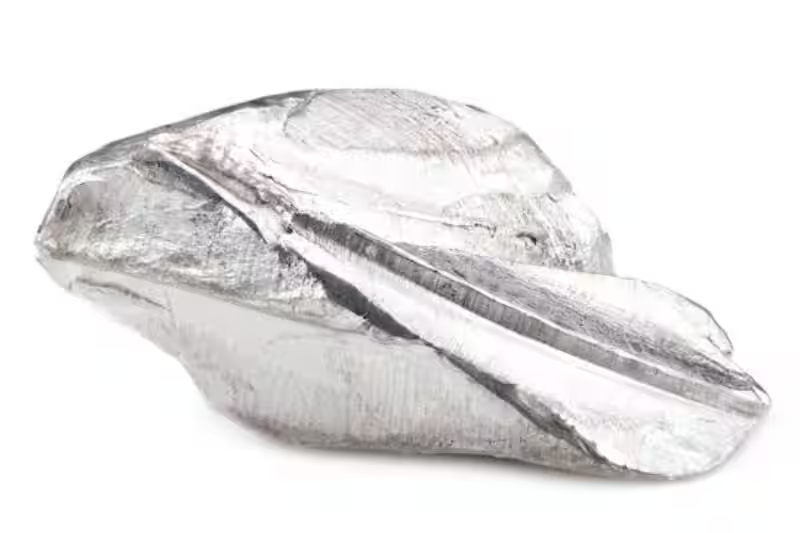
Indium(III) chloride exists as a white, flaky solid, readily identifiable by its appearance. It also forms a tetrahydrate, InCl₃·4H₂O, which retains similar chemical properties but differs slightly in its physical characteristics. The defining characteristic of InCl₃ is its exceptional solubility in water and other polar solvents. This high solubility makes it a preferred starting material in many chemical reactions.
The synthesis of InCl₃ is relatively straightforward. A direct method involves the vigorous reaction of indium metal with chlorine gas. This exothermic reaction produces InCl₃ directly, requiring careful control of reaction conditions to prevent side reactions or hazards. Alternatively, electrochemical methods using methanol-benzene solutions provide a cleaner and more controlled route to obtaining high-purity InCl₃.
Structural Features of InCl₃ and its Hydrate
The solid-state structure of InCl₃ reveals a layered arrangement, similar to that of yttrium trichloride (YCl₃). This contrasts sharply with the dimeric structure observed in gallium trichloride (GaCl₃), highlighting differences in the bonding behavior of these group 13 elements. The indium(III) centers in InCl₃ are octahedrally coordinated by chloride ions within a closely packed chloride lattice.
The tetrahydrate, InCl₃·4H₂O, on the other hand, adopts an orthorhombic crystal system. Its structure is built from [InCl₃(H₂O)₂] units, linked together via bridging water molecules of crystallization. This structural difference influences its solubility and reactivity compared to the anhydrous form. Understanding these structural nuances is crucial for predicting and controlling its behavior in various applications.
Reactivity and Chemical Behavior of Indium Trichloride
The chemical reactivity of indium trichloride is largely dictated by its Lewis acidity. This means it readily accepts electron pairs from donor ligands (L), forming a series of complexes with varying stoichiometry, such as InCl₃L, InCl₃L₂, and InCl₃L₃. The nature of the ligand significantly impacts the stability and properties of these complexes.
Indium trichloride also reacts readily with chloride ions (Cl⁻) to form anionic complexes, including the tetrahedral [InCl₄]⁻, the trigonal bipyramidal [InCl₅]²⁻, and the octahedral [InCl₆]³⁻. The formation of these complexes influences its behavior in solution and its ability to act as a catalyst. Reactions with organometallic reagents are equally noteworthy. For example, reacting InCl₃ with lithium hydride (LiH) in diethyl ether provides the unstable but useful reducing agent lithium tetrahydroindate(III) (Li[InH₄]). Grignard reagents (e.g., CH₃MgI, EtMgBr) or methyllithium (LiCH₃) react to yield organoindium compounds, such as trimethylindium (InMe₃) and triethylindium (InEt₃), crucial building blocks in organometallic chemistry. High-temperature reactions with indium metal lead to the formation of lower valent indium chlorides, such as In₅Cl₉, In₂Cl₃, and InCl, demonstrating the versatility of InCl₃ in redox reactions.
Applications of Indium Trichloride: From Catalysis to Advanced Materials
One of the most significant applications of indium trichloride is its use as a Lewis acid catalyst in organic synthesis. Its ability to activate substrates and facilitate reactions makes it a valuable tool in several organic transformations. It demonstrates effectiveness in Friedel-Crafts acylations and Diels-Alder reactions, enhancing both yield and selectivity.
Indium Trichloride as a Catalyst
In a notable example involving a Diels-Alder reaction between N,N'-dimethylbarbituric acid, benzaldehyde, and ethyl vinyl ether, the addition of indium trichloride significantly improves the yield (from 65% to 90%) and increases the percentage of the trans isomer (from 50% to 70%) at room temperature. Remarkably, this enhancement is achieved using only a low catalyst loading of 1 mole%, highlighting its efficiency and catalytic power. This catalytic activity underscores its importance in achieving cleaner and more efficient chemical processes. Beyond its role in well-established reactions, research is ongoing to explore its potential in newer and more specialized organic transformations.
Beyond catalysis, indium trichloride finds use as a precursor in the synthesis of other indium compounds, both inorganic and organic. This makes it a crucial intermediate in the production of various materials. Its role extends to the production of alkaline batteries, where it contributes to improved performance and reduced outgassing. Additionally, the semiconductor industry utilizes indium trichloride in the synthesis of quantum dots, nanoscale semiconductor crystals with unique optical properties finding applications in displays, sensors, and biomedical imaging. The versatility of indium trichloride makes it a valuable compound in diverse technological fields, contributing to innovation across several sectors. Further research and development may unlock even more applications for this versatile compound in the future.
Indium Trichloride (InCl₃) FAQ
What is Indium Trichloride (InCl₃)?
Indium(III) chloride (InCl₃) is an important indium compound appearing as a white, flaky solid. It also exists as a tetrahydrate (InCl₃·4H₂O). Its high solubility in water makes it a readily available and convenient source of soluble indium.
How is Indium Trichloride synthesized?
InCl₃ is synthesized relatively easily. One method involves the direct reaction of indium metal with chlorine gas. Electrochemical methods in methanol-benzene solutions can also produce InCl₃.
What is the structure of Indium Trichloride?
InCl₃ possesses a layered structure similar to YCl₃, unlike the dimeric structure of GaCl₃. The indium(III) ions are octahedrally coordinated within a close-packed chloride arrangement. In the molten state, it conducts electricity, unlike the non-conducting dimeric AlCl₃. The tetrahydrate has an orthorhombic crystal structure.
What is the reactivity of Indium Trichloride?
InCl₃ acts as a Lewis acid, readily forming complexes with donor ligands (L), creating compounds such as InCl₃L, InCl₃L₂, and InCl₃L₃. Reactions with chloride ions yield tetrahedral [InCl₄]⁻, trigonal bipyramidal [InCl₅]²⁻, and octahedral [InCl₆]³⁻ complexes. It also reacts with lithium hydride to produce lithium tetrahydroindate(III) (Li[InH₄]), a reducing agent. Reactions with Grignard reagents or methyllithium produce organoindium compounds like trimethylindium (InMe₃). High-temperature reactions with indium metal can yield lower valent indium chlorides (e.g., In₅Cl₉, In₂Cl₃, InCl).
A major application is its catalytic activity in organic synthesis. It serves as a Lewis acid catalyst in reactions like Friedel-Crafts acylations and Diels-Alder reactions, improving yields and selectivity. For example, it significantly enhances the yield and trans isomer percentage in a specific Diels-Alder reaction. Further applications are being explored in the synthesis of other indium compounds for use in diverse technological sectors, including alkaline batteries and quantum dot production.
Is Indium Trichloride soluble in water?
Yes, Indium Trichloride is highly soluble in water and mineral acids, contributing to its ease of use in various applications.
What form is Indium Trichloride available in?
Indium Trichloride is commercially available in both powder and solution forms.
Is Indium Trichloride a strong or weak Lewis acid?
Indium Trichloride is a relatively strong Lewis acid due to its ability to readily accept electron pairs from donor ligands.
What are some examples of complexes formed by Indium Trichloride?
Examples include InCl₃L, InCl₃L₂, InCl₃L₃, [InCl₄]⁻, [InCl₅]²⁻, and [InCl₆]³⁻, where L represents a donor ligand.
How does Indium Trichloride improve battery performance?
Its inclusion in alkaline batteries improves efficiency and reduces outgassing, leading to longer battery life and improved safety.
What role does Indium Trichloride play in quantum dot production?
It serves as a precursor in the synthesis of quantum dots, contributing to the development of these nanomaterials with unique optical properties.
Is Indium Trichloride used as a catalyst in industrial processes?
While specific industrial applications aren't fully detailed, its catalytic properties suggest potential use in various industrial chemical processes.
What are some safety precautions when handling Indium Trichloride?
Standard laboratory safety procedures should be followed when handling any chemical. Specific safety data sheets (SDS) should be consulted for detailed handling, storage, and disposal instructions.
Where can I find more information about InCl3?
Consult reputable scientific databases and chemical supplier websites for detailed information, including safety data sheets (SDS).