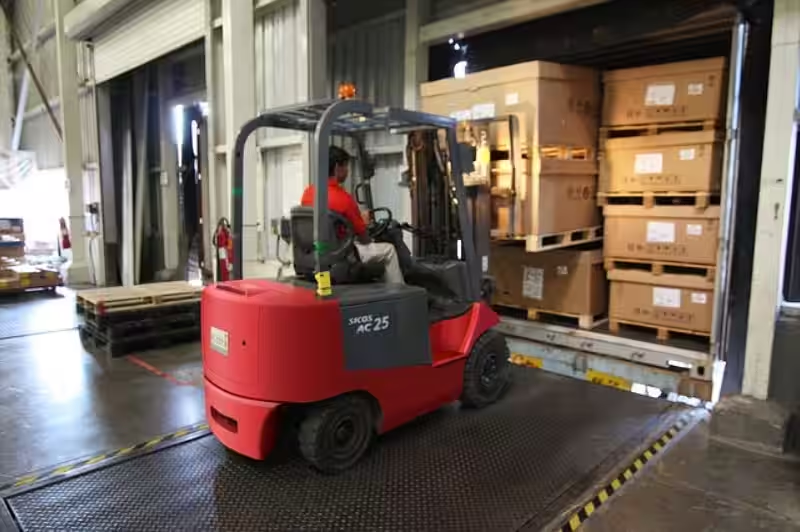
Forklift Toolbox Talk: Preventing Accidents and Ensuring Safety
Forklift Toolbox Talk: Preventing Accidents and Ensuring Safety
Forklifts are indispensable in many workplaces, boosting efficiency and reducing manual handling risks. However, their power also presents significant dangers. Improper use can lead to serious accidents, injuries, and even fatalities. This article will guide you through a comprehensive forklift toolbox talk, outlining crucial safety procedures and preventative measures. Understanding these points is critical for creating a safer work environment for everyone.
Before operating a forklift, comprehensive training is absolutely essential. This isn't just about learning how to drive; it's about understanding the inherent risks and developing safe operating habits. A qualified instructor should cover all aspects of operation, from pre-operation checks to emergency procedures.
Proper training equips operators with the knowledge and skills to identify and mitigate potential hazards. It's not simply about following instructions; it's about cultivating a safety-first mindset that becomes second nature. This proactive approach significantly reduces the likelihood of accidents.
Key Safety Practices for Forklift Operation
A successful forklift toolbox talk always emphasizes practical safety measures. Here are some critical points to remember:
Always wear your seatbelt: This seemingly simple action significantly reduces the risk of injury in the event of a rollover.
Handling inclines: When ascending or descending inclines, keep the load uphill and drive forward when going uphill, backward when going downhill.
Unloaded fork height: Maintain a safe distance from the ground (typically 4-6 inches) when the forks are not carrying a load.
Never walk under raised loads: This is a fundamental rule to avoid potentially fatal injuries from falling loads.
Check blind corners and use your horn: This helps avoid collisions, especially in busy environments.
Reverse and turn with high loads: With a load that obstructs your view, reverse and turn carefully to maintain visibility.
Maintain safe distances: Keep a safe distance (approximately three forklift lengths) from other forklifts.
Avoid surprising others: Never approach someone from behind unexpectedly – always make eye contact and ensure you're seen.
Park safely: When parked or unattended, ensure forks are lowered, controls are neutral, and the parking brake is engaged.
A forklift toolbox talk should always stress the importance of proper load preparation. Before you even lift, carefully assess:
Load stability: Is the load secure and unlikely to shift during transportation?
Load condition: Is the load damaged or unstable in any way?
Load centering: Is the load properly centered, with the heaviest part closest to the front wheels?
Weight capacity: Does the load weight comply with the forklift's stated capacity?
Load extension backrest: Is the load extension backrest used if needed to prevent the load from tipping backward?
Failure to properly assess the load can have serious consequences.
Step-by-Step Guide to Safe Forklift Operation
This section demonstrates a typical forklift toolbox talk scenario, walking through the process of safely lifting and transporting a load:
Approaching the load: Position the forklift 8-12 inches in front of the load, ensuring correct fork height and neutral direction control.
Fork placement: Level the forks before insertion, ensuring they're fully under the load (at least two-thirds of its length), and center the weight. Tilting the mast can help with stabilization.
Lifting the load: Check overhead clearance before raising the load approximately 4 inches above the lower stack. Tilt the mast back to rest the load against the backrest extension, then return the lift control lever to neutral.
Safe transportation: Adhere to all previously mentioned safety guidelines during transportation.
A Forklift Toolbox Talk: Addressing Common Hazards
A successful forklift toolbox talk should also address the most common causes of accidents:
Overturning: This is a leading cause of forklift fatalities. Uneven terrain, excessive speed, improper load distribution, and exceeding weight capacity are all contributing factors.
Collisions: Collisions with other forklifts, pedestrians, or fixed objects are common. Lack of awareness, poor visibility, and inadequate space are often to blame.
Falling loads: Loads can fall due to improper securing, exceeding weight capacity, or sudden braking.
Pedestrian injuries: Pedestrians can be injured by being struck by the forklift or by falling loads. Clear pathways and designated pedestrian areas are crucial.
Forklift safety is not solely the responsibility of the operator. Everyone in the workplace has a role to play. Supervisors should ensure proper training and enforce safety regulations. Workers should be aware of their surroundings and report any unsafe conditions immediately. A strong safety culture, fostered through regular toolbox talks and open communication, is crucial for creating a safe and productive work environment. A regular, effective forklift toolbox talk is a vital part of maintaining that culture. Remember: safety isn't just a rule; it's a shared commitment to protecting lives and promoting productivity.
Forklift Toolbox Talk: Frequently Asked Questions
What is the main purpose of this forklift safety toolbox talk?
This toolbox talk emphasizes safe forklift operation to prevent injuries and maintain workplace productivity. While forklifts boost efficiency and reduce manual handling risks, improper use can lead to serious accidents. The talk focuses on preventative measures and proper operating procedures to ensure a safe working environment.
Why is forklift training so important?
Comprehensive forklift training is crucial before operating any forklift. Training equips operators with the knowledge and skills necessary to handle forklifts safely, minimizing the risk of accidents. It covers safe operating procedures, hazard identification, and emergency response.
What are some key safety practices highlighted in the toolbox talk?
Several key practices are stressed: always wearing seatbelts; handling inclines by keeping the load uphill and driving forward uphill/backward downhill; maintaining forks 4-6 inches off the ground when unloaded; preventing anyone from walking under raised loads; checking blind corners and using the horn; reversing and turning when a high load obstructs vision; maintaining a safe distance (approximately three forklift lengths) from other forklifts; never approaching someone from behind unexpectedly; ensuring forks are lowered, controls are neutral, and the parking brake is engaged when parked or unattended; and making eye contact with those nearby.
Before lifting, ensure the load is stable, undamaged, properly centered (heaviest part closest to the front wheels), and does not exceed the forklift's weight capacity. Use the load extension backrest when necessary.
What is the correct procedure for approaching and placing the forks under a load?
Position the forklift 8-12 inches in front of the load. Ensure correct fork height and neutral direction control. Level the forks before insertion, ensuring they're fully under the load (at least two-thirds of its length), and center the weight. Mast tilting for load stabilization is recommended.
How should I lift and transport a load safely?
Check overhead clearance before raising the load approximately 4 inches above the lower stack. Tilt the mast back to rest the load against the backrest extension, and return the lift control lever to neutral. During transportation, adhere to all previously mentioned safety guidelines.
What is the shared responsibility regarding forklift safety?
Forklift safety is a shared responsibility. It's not just the operator's responsibility; everyone in the workplace has a role in maintaining a safe environment. This includes pedestrians, supervisors, and maintenance personnel.
What are some common causes of forklift accidents?
Common causes include operator error (lack of training, speeding, disregarding safety rules), mechanical failure (damaged forks, faulty brakes), and environmental factors (uneven terrain, obstructed views, congested areas).
How can I reduce the risk of forklift accidents?
Following safe operating procedures, undergoing proper training, regular forklift maintenance, and maintaining a safe work environment (clear pathways, proper signage) are crucial in reducing accident risks. A proactive and cautious approach, avoiding complacency, is essential.
What should I do if a forklift tips over?
If a tip-over occurs, remain in the forklift and brace yourself. Jumping out is more dangerous. Report the incident immediately to your supervisor.