How to Prepare Documents That Everyone Can Understand
How to Prepare Documents That Everyone Can Understand
Preparing documents might seem straightforward, but crafting clear and accessible materials is a skill that can significantly impact their effectiveness. This guide focuses on techniques to ensure your documents are easy to understand for everyone, regardless of their background or expertise. Whether you're writing internal memos, official reports, or public-facing materials, understanding how to prepare documents effectively is crucial.
One of the most impactful ways to improve document accessibility is by using simple, everyday language. Avoid jargon, technical terms, and complex sentence structures. Strive for clarity and conciseness in your writing.
Instead of relying on specialized vocabulary, opt for words that are commonly understood. For example, use "start" instead of "initiate," "end" instead of "terminate," and "help" instead of "facilitate." This approach ensures that your message resonates with a wider audience. If you must use a technical term, be sure to define it clearly within the text. This proactive approach prevents any potential confusion.
The Power of Active Voice: Direct and Engaging Communication
Active voice significantly enhances clarity and directness in your writing. When you use active voice, the subject of the sentence performs the action. For instance, "The team completed the project" is active voice, while "The project was completed by the team" is passive voice.
Active voice creates more engaging and easier-to-understand sentences. It allows the reader to quickly grasp the subject and the action being performed. While passive voice has its applications (particularly when the actor is unknown or unimportant), prioritize active voice for most of your writing to ensure maximum impact and readability. Remember to always prepare documents with your audience in mind.
Avoiding Passive Voice Pitfalls
While passive voice isn't always a bad thing, overuse can make your writing sound clunky and less direct. Consider this example: "The report was written by John." This is passive voice. The active voice equivalent, "John wrote the report," is far more concise and easier to understand. By using active voice, you ensure that your message is delivered cleanly and effectively. Prepare documents carefully.
Constructing Clear and Concise Sentences
Sentence structure is another crucial element of clear writing. Keep your sentences concise and avoid overly long or complex constructions. Aim for a subject-verb-object order whenever possible. This natural sentence structure makes your writing easy to follow.
Overly long sentences can confuse the reader, making it difficult to follow the flow of your ideas. Break down lengthy sentences into shorter, more manageable units. Reading your work aloud is a great way to identify awkward phrasing or overly complex sentences. This technique helps you refine your writing and ensure clarity. By preparing documents with this technique, you can easily spot awkward sentences.
Techniques for Sentence Refinement
To improve sentence structure, consider the following:
Limit the number of clauses: Avoid embedding too many clauses within a single sentence.
Use shorter words: Opt for shorter, simpler words whenever possible.
Remove unnecessary words: Eliminate any words that don’t contribute to the overall meaning.
Vary sentence length: A mix of short and long sentences can improve readability.
By consistently applying these techniques, your writing will become much clearer and easier to understand for your audience.
Prepare Documents: The Importance of Accessibility
The ultimate goal when preparing documents is to ensure accessibility for all readers. Regardless of the specific purpose of your document, you should aim for clarity and simplicity. If you're preparing documents for a diverse audience, consider employing additional accessibility features, like:
Using clear headings and subheadings: This helps readers easily navigate the document.
Using bullet points and lists: These make information easier to digest.
Using visuals like charts and graphs: These can effectively convey complex information.
Providing alternative text for images: This is crucial for visually impaired readers.
Remember that accessibility isn't just about making your documents easier to read; it's about ensuring that everyone can access and understand the information you're presenting. By preparing documents with accessibility in mind, you can ensure that your message reaches the widest possible audience.
When to Seek Professional Help: Knowing Your Limits
While this guide empowers you to prepare documents independently for simpler tasks, it's important to recognize the limitations of self-preparation. Complex legal or financial matters often require the expertise of a professional.
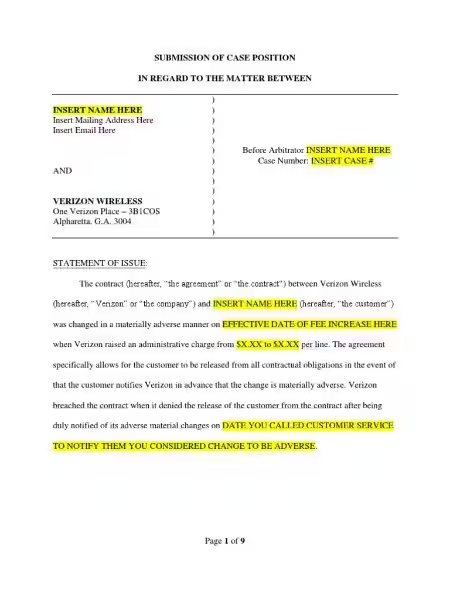
Attempting to handle intricate legal issues without professional guidance can have serious consequences. For instance, drafting a poorly written contract could lead to disputes and costly litigation. Similarly, complex financial documents require specialized knowledge to ensure accuracy and compliance. Knowing when to seek professional help is crucial in protecting your interests.
Differentiating Simple from Complex Tasks
The ability to self-prepare documents effectively depends heavily on the complexity of the task. Simple forms, such as name change applications or basic employment contracts, are often manageable for self-preparation. However, complex legal documents like wills, trusts, or contracts involving significant financial transactions necessitate the assistance of a legal or financial professional. Always err on the side of caution when dealing with complex issues.
In conclusion, preparing documents effectively involves a multifaceted approach that encompasses the use of simple language, active voice, concise sentence structures, and a strong focus on accessibility. By adhering to these guidelines, you will create documents that are clear, understandable, and readily accessible to a broad audience. Remember to recognize the limits of self-preparation and seek professional help when necessary.
Preparing Clear and Accessible Documents: FAQ
How can I write clear and easy-to-understand documents?
This guide focuses on making your writing accessible to everyone. The key is to use simple words and sentence structures, avoiding complicated language and technical jargon. Replace complex terms with everyday equivalents (e.g., "breathe" instead of "inhale"). If you must use a technical term, be sure to define it clearly. You can use appendices for more detailed explanations.
What is the importance of using simple words?
Using simple words makes your document accessible to a wider audience, regardless of their background or level of expertise. Avoid technical jargon and replace it with everyday language. This enhances comprehension and prevents confusion. Consult resources like the Environmental Health Thesaurus and Everyday Words for Public Health Communication for simpler alternatives.
Why is active voice preferred over passive voice?
Active voice makes your writing clearer and more direct. Sentences in active voice follow a subject-verb-object order, making them easier to understand and more natural-sounding. For example, "The agency completed the report" (active) is clearer than "The report was completed by the agency" (passive). While passive voice has its uses (e.g., when the actor is unknown), active voice should be your default choice.
How can I ensure my sentences are well-structured?
Keep your sentences concise and avoid lengthy phrases between the subject and verb. A clear subject-verb-object structure will ensure your writing flows smoothly and is easy to follow. To identify awkward phrasing or overly complex sentences, read your work aloud. This helps pinpoint areas that need simplification.
What resources can help me find simpler words and phrases?
The Environmental Health Thesaurus and Everyday Words for Public Health Communication are excellent resources for finding simpler alternatives to technical terms and complex phrases. These resources offer equivalents that are more accessible to a broader audience.
When should I consider using passive voice?
While active voice is generally preferred for clarity, passive voice is appropriate when the actor performing the action is unknown or unimportant. For instance, "The window was broken" is acceptable when the culprit is unknown. However, overuse of passive voice can make your writing unclear and less engaging.
How can I check for awkward phrasing or overly complex sentences?
Reading your work aloud is a highly effective way to identify areas that need simplification. Hearing your writing will help you catch awkward phrasing, overly long sentences, or confusing structures that might not be apparent when reading silently.
Should I always prepare legal documents myself?
Preparing straightforward legal documents like simple employment contracts or advanced directives can save time and money. However, complex legal matters like mergers, divorces, or significant estate planning absolutely require professional legal assistance. Self-preparation for complex issues can have serious consequences.
What are some examples of legal documents suitable for self-preparation?
Simple documents with established formats and uncomplicated legal concepts, such as basic employment contracts, service agreements, simple name change forms, and basic advanced directives are generally suitable for self-preparation, provided you understand the potential risks and limitations.
What are the potential risks of preparing legal documents without professional help?
Attempting to handle complex legal issues without legal expertise can result in invalid contracts, costly litigation, and unfavorable outcomes. This risk increases significantly with the complexity of the legal matter.
How can I determine if I need professional legal assistance?
Assess the complexity of the legal issue and its potential ramifications. Simple documents with clear precedents and readily available templates might be manageable, but complex or high-stakes matters demand professional help. If in doubt, seek professional legal advice.
What is the best approach to preparing legal documents?
A responsible approach involves a clear assessment of the document's complexity and potential legal consequences. For straightforward documents, self-preparation may be acceptable with an understanding of the risks. However, for complex or high-stakes situations, consulting a licensed attorney is essential.
Where can I find templates for straightforward legal documents?
Many online resources and legal guides offer templates for common straightforward legal documents. However, always verify the accuracy and applicability of these templates to your specific situation and jurisdiction. It is advisable to consult with a legal professional even when using templates.
Are there any limitations to using online templates for legal documents?
Online templates may not always be suitable for every situation. They might not accurately reflect the specific legal requirements of your jurisdiction or address all the nuances of your particular circumstances. Use caution and seek legal advice if needed.
What happens if I make a mistake in a self-prepared legal document?
Errors in self-prepared legal documents can lead to legal disputes, financial losses, and enforceability issues. The consequences can be significant, especially in complex matters.