Choosing the Right Competency Rating Scale: A Guide for Effective Performance Reviews
Choosing the Right Competency Rating Scale: A Guide for Effective Performance Reviews
Picking the right performance review system can feel overwhelming. But the process of choosing a competency rating scale doesn't have to be. This article will guide you through the key considerations, different types of scales, and best practices to ensure your performance reviews are accurate, fair, and actionable.
Understanding Data Types in Performance Appraisals
Before diving into specific rating scales, let's clarify the types of data they generate. Performance appraisals often utilize three main data types:
Nominal Data: This is categorical data without any inherent order. For example, an employee's department (Sales, Marketing, etc.) is nominal data.
Binary Data: This is a simple yes/no or true/false type of data. Did the employee meet the deadline? Yes/No.
Ordinal Data: This represents ordered categories. This is the most common type used in competency rating scales. Think of ratings like "Unsatisfactory," "Meets Expectations," "Exceeds Expectations"—there's a clear order, but the differences between levels aren't necessarily equally spaced.
The choice of data type will significantly influence the type of competency rating scale you can use. Ordinal data is the foundational element that allows for ranked evaluations of employee performance.
Presentation Styles for Rating Scale Answers
Once you've chosen your data type, the next step is to decide how you'll present the response options. There are two main approaches:
Numeric Scales: These use numbers only (e.g., 1-5). While simple, they can be difficult to interpret subjectively. What does a "3" truly mean? Without a clear definition, it’s open to interpretation and potential bias.
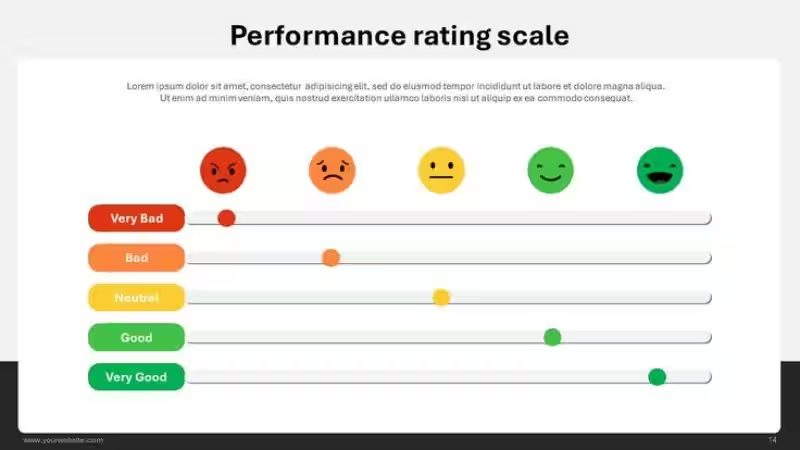
Descriptive Scales: These use text descriptions for each rating level (e.g., "Unsatisfactory," "Needs Improvement," "Meets Expectations," "Exceeds Expectations"). Descriptive rating scales provide greater context and clarity, minimizing ambiguity and promoting consistency in evaluation.
The descriptive approach generally leads to more accurate and consistent evaluations, particularly when combined with detailed descriptions for each level.
Common Rating Scale Types
Several common rating scale types exist, each with its strengths and weaknesses:
These scales present statements, and employees indicate their level of agreement using options ranging from "Strongly Disagree" to "Strongly Agree." A crucial decision is whether to use an odd number of options (allowing for a neutral response) or an even number (forcing a choice). The best choice depends on the context and the specific goals of the evaluation.
Even-numbered scales can push employees to choose a side, but odd-numbered scales might lead to an overreliance on the neutral option.
Semantic Differential Scales
Similar to Likert scales, semantic differential scales present two opposite extremes (e.g., "Highly Effective" to "Ineffective"). However, instead of pre-defined levels of agreement, the respondent places their mark along a continuous line between the two extremes. This approach allows for greater nuance in the responses.
The challenge lies in the subjectivity and difficulty in standardizing interpretation across different raters.
Custom Scales
These offer maximum flexibility but require careful design to prevent data distortion. A well-designed custom scale can be highly effective, but a poorly designed one can introduce significant bias and inaccuracy.
Creating a custom scale requires thorough consideration of the specific competencies to be assessed and the desired level of granularity. It's essential to define each level clearly and provide concrete examples to ensure consistency in evaluation.
Real-World Examples of Competency Rating Scales
Various organizations use diverse competency rating scales. UC Berkeley might use a five-point scale, while Huntington Ingalls Industries might utilize a four-point scale with detailed behavioral descriptions. Harvard and Emory University might employ custom scales tailored to their specific needs and departmental structures. These examples demonstrate the flexibility and adaptability of rating scales.
The key takeaway is that there is no one-size-fits-all solution. The ‘best’ competency rating scale depends entirely on your organizational culture, goals, and the specific competencies being assessed.
Behaviorally Anchored Rating Scales (BARS)
BARS represent a more sophisticated approach. They anchor each rating level with specific observable behaviors that illustrate performance at each level. This reduces subjectivity and increases the reliability of the evaluations. This is particularly useful for measuring complex skills or behaviours.
For instance, a BARS for "Teamwork" might define "Exceeds Expectations" with examples like "Frequently volunteers to help colleagues," "Proactively shares resources," and "Contributes to a positive team environment," in contrast to "Meets Expectations" which might focus on "Completes assigned teamwork tasks effectively."
Best Practices for Implementing a Competency Rating Scale
Regardless of the specific scale you choose, several best practices apply:
Clearly Defined Criteria: Ensure the criteria for each rating level are clearly defined and unambiguous.
Detailed Descriptions: Provide detailed descriptions of the behaviors and performance levels associated with each rating, minimizing subjective interpretation.
Regular Calibration: Regularly calibrate the rating scale among raters to ensure consistency.
Training: Provide training to raters on how to use the scale effectively and avoid bias.
Feedback: Focus on providing constructive feedback, not just assigning a rating.
The key is to use the chosen competency rating scale consistently and fairly, always ensuring the process is transparent and the feedback provided is actionable and valuable for employee development. The goal is to improve performance, not simply assign numbers.
What is a Competency Rating Scale?
A competency rating scale is a performance evaluation tool that assesses an employee's proficiency in specific skills and abilities (competencies) crucial for their role. Unlike generic rating scales focusing on overall performance, competency scales break down performance into individual competencies, providing a more detailed and targeted evaluation. This allows for more specific feedback and identification of areas for improvement or further development. The scale typically uses a numerical or descriptive rating system to indicate the level of competency demonstrated.
What are the benefits of using a Competency Rating Scale?
Competency rating scales offer several advantages. They provide more targeted feedback, allowing employees to understand their strengths and weaknesses more precisely. This granularity also helps managers identify training needs and tailor development plans more effectively. Furthermore, they contribute to fairer and more objective evaluations by focusing on observable behaviors and skills rather than subjective impressions. The detailed feedback facilitates constructive conversations during performance reviews, leading to improved performance and employee engagement.
How do Competency Rating Scales differ from other rating scales?
Unlike simple numerical scales (e.g., 1-5), competency scales go beyond a general assessment. They specifically identify and evaluate key competencies relevant to a particular job. This contrasts with Likert scales, which focus on agreement with statements, or semantic differential scales, which assess attitudes along bipolar dimensions. While those scales can incorporate competency-related items, competency rating scales are specifically designed to measure proficiency in pre-defined competencies.
What are some common types of Competency Rating Scales?
Several formats exist for competency rating scales. Some use numerical ratings (e.g., 1-5, where 5 represents exemplary performance), while others rely on descriptive labels (e.g., "Unsatisfactory," "Meets Expectations," "Exceeds Expectations"). Some scales incorporate behavioral anchors, providing specific examples of behavior for each rating level. This approach, known as Behaviorally Anchored Rating Scales (BARS), enhances the objectivity and clarity of the rating process. The choice of scale depends on the organization's culture, the complexity of the roles, and the desired level of detail in the evaluation.
How many points should a Competency Rating Scale have?
The optimal number of points on a competency rating scale is context-dependent. Common choices include 3, 4, or 5 points. A 3-point scale (e.g., Needs Improvement, Meets Expectations, Exceeds Expectations) is concise but may lack nuance. A 4 or 5-point scale offers greater granularity but can increase complexity. The key is to choose a number of points that balances detail with ease of use and interpretation, ensuring the scale remains practical for both raters and ratees.
How can I ensure fairness and avoid bias when using a Competency Rating Scale?
Fairness and objectivity are crucial. To minimize bias, clearly define each competency with observable behavioral indicators. Provide detailed descriptions for each rating level, ensuring transparency and consistent interpretation. Train raters on the use of the scale and the importance of unbiased evaluation. Regularly review and update the scale to maintain its relevance and accuracy. Consider incorporating multiple raters for each employee to gain a more comprehensive perspective and mitigate individual biases. Finally, ensure the process includes opportunities for employee feedback and discussion.