Choosing the Right Employee Rating Scale: A Guide for Effective Performance Management
Choosing the Right Employee Rating Scale: A Guide for Effective Performance Management
Choosing the right employee rating scale is crucial for effective performance management. While there's no single "best" scale, selecting a system that aligns with your company culture and goals is paramount. Successful implementation hinges on building employee trust and using the collected data to drive both individual and departmental improvement. This article will explore different types of employee rating scales and offer guidance on selecting the most appropriate one for your organization.
Understanding Different Data Types in Performance Reviews
Before diving into specific rating scales, it's important to understand the different types of data used in performance reviews. These data types influence the structure and interpretation of your employee rating scale.
Three primary data types are commonly employed:
Nominal: This type of data represents categories without any inherent order. For example, an employee's department (Sales, Marketing, Engineering) is nominal data. It simply categorizes, without ranking.
Binary: This involves data with only two possible values, representing a yes/no or true/false distinction. An example would be whether an employee completed a project (complete/incomplete). Binary data offers a simple, direct assessment.
Ordinal: This data type involves ranked categories, forming the basis of most employee rating scales. Examples include rankings from "strongly agree" to "strongly disagree" or performance levels from "unsatisfactory" to "exceeds expectations." This is where the core of employee rating scales lies.
Numeric vs. Descriptive Rating Scales: A Comparison
Within ordinal data, we find two main approaches to constructing employee rating scales: numeric and descriptive.
Numeric scales use numbers (e.g., 1-5) to represent performance levels. While simple, these scales are often criticized for their ambiguity. What does a "3" actually mean? The lack of clear definitions can lead to inconsistencies in ratings and unfair evaluations.
Descriptive scales, on the other hand, provide detailed descriptions for each rating level, offering greater clarity and reducing ambiguity. This leads to more consistent and fair evaluations. Several common descriptive scales exist:
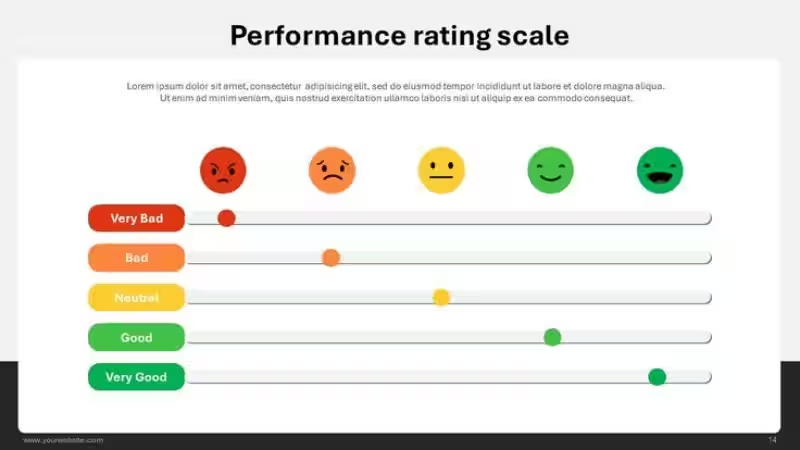
Likert scales measure agreement or disagreement with statements using a range of options (e.g., strongly agree, agree, neutral, disagree, strongly disagree). A critical decision when using a Likert scale is whether to include a neutral option (odd number of options) or force a choice (even number of options). The choice impacts the data and interpretation.
Semantic Differential Scales
These scales present two opposite extremes, with unspecified levels in between (e.g., success/failure, highly motivated/unmotivated). This allows for a nuanced assessment, but requires careful wording to avoid bias and ensure clear interpretation.
Custom Scales
Companies can design custom scales tailored to their specific needs and values. However, this requires careful planning and consideration to avoid data distortion and ensure fairness and consistency. The descriptions must be detailed and unambiguous.
Real-World Examples of Employee Rating Scales
Many organizations use different approaches to employee rating scales. For instance:
UC Berkeley: Uses a 5-level scale, with low ratings triggering performance improvement plans.
Huntington Ingalls: Employs a numerical scale complemented by alphabetical abbreviations for brevity.
Harvard University: Implements multiple scales for overall performance, individual goals, competencies, and performance of direct reports.
Emory University: Utilizes a competency-based system with a 3-point scale.
Numerous other organizations use 1-3, 1-4, and 1-5 point scales, each with varying descriptive anchors to provide context and clarity. The choice depends heavily on the specific needs of the organization and its performance management goals.
Frequently Asked Questions about Employee Rating Scales
Choosing the right employee rating scale can be challenging. Here are some frequently asked questions to consider:
What is the best rating scale? There is no universally "best" scale. The ideal choice depends on your company's specific needs, culture, and goals.
What are the most commonly used scales? 3- and 4-point scales are frequently used due to their simplicity and relative ease of interpretation.
What are Behaviorally Anchored Rating Scales (BARS)? BARS use specific behavioral descriptions to anchor each rating level, improving rater consistency and reducing ambiguity.
What are competency rating scales? These scales assess employee proficiency across different skill areas, providing a holistic view of performance.
Providing effective feedback is crucial. This involves consistent, clear communication, and acknowledging good performance. Remember, the employee rating scale is just a tool; its effectiveness relies on thoughtful implementation and a commitment to fair and transparent performance management. Careful consideration of the chosen employee rating scale, aligning it with organizational objectives and values, is essential for ensuring fairness, transparency, and ultimately, improved performance management.
What is the best employee rating scale?
There's no single "best" employee rating scale. The optimal choice depends entirely on your company's specific culture, goals, and the type of data you need to collect. Factors to consider include the level of detail required, the need for a neutral option, and how the data will be used for performance improvement and decision-making. Popular options include 3-point, 4-point, and 5-point scales, each with variations in descriptive anchors.
What are the different types of rating scales?
Employee rating scales generally fall under ordinal data, meaning they represent ranked data. Within this category, we have:
Numeric scales: These use numbers (e.g., 1-5) to represent performance levels. While simple, they can be ambiguous without clear descriptions for each number.
Descriptive scales: These provide detailed descriptions for each rating level, offering greater clarity and reducing ambiguity. Examples include Likert scales (measuring agreement with statements), semantic differential scales (presenting opposite extremes), and custom scales (tailored to specific company needs). Behaviorally Anchored Rating Scales (BARS) are a sophisticated type of descriptive scale that uses specific behavioral examples to anchor each rating level.
What are the most commonly used rating scales?
Research suggests that 4-point and 5-point scales are the most prevalent, with 3-point scales also being commonly used. The optimal number of points will depend on your specific needs and the level of granularity desired. A 3-point scale might suffice for simple evaluations, while a 5-point scale allows for more nuanced distinctions in performance.
How can I avoid common pitfalls in designing an employee rating scale?
Several common mistakes can undermine the effectiveness of an employee rating scale. These include:
Poorly defined rating levels: Vague descriptions lead to inconsistent ratings and unfair evaluations. Ensure each level is clearly defined with specific examples.
Rater bias: Leniency (giving everyone high scores) and centrality (giving everyone average scores) biases distort results. Training managers to recognize and mitigate these biases is crucial.
Lack of transparency: Employees must understand how the rating scale works and how their ratings are used. Open communication builds trust and fairness.
Ignoring employee feedback: Regular feedback from employees on the rating system itself is vital for continuous improvement and buy-in.
What are some best practices for using employee rating scales?
Align the scale with company goals: Ensure the rating criteria directly reflect the organization's values and strategic objectives.
Provide detailed descriptions: Use clear and specific descriptions for each rating level to minimize ambiguity.
Train raters effectively: Managers need training to understand and apply the rating scale consistently and fairly.
Use multiple data sources: Don't rely solely on the rating scale. Incorporate other data points, such as self-assessments, peer reviews, and project outcomes, for a more holistic view of performance.
Focus on feedback and development: Use the rating scale as a tool for constructive feedback and identifying areas for employee growth. The goal is improvement, not just assigning a number.
By carefully considering these factors and avoiding common pitfalls, organizations can design and implement effective employee rating scales that contribute to a fair, transparent, and productive work environment.