Understanding Ethylenebis Compounds: From Release Agents to More
Understanding Ethylenebis Compounds: From Release Agents to More
Ethylenebis compounds represent a fascinating class of organic molecules with diverse industrial applications. Their versatility stems from the central ethylenediamine backbone, which can be modified to create a wide range of derivatives with unique properties. This article will explore the properties and uses of several prominent ethylenebis compounds, focusing specifically on ethylenebis(stearamide) and highlighting the importance of understanding their chemical structure-property relationships.
Ethylenebis(stearamide) (EBS): A Versatile Industrial Workhorse
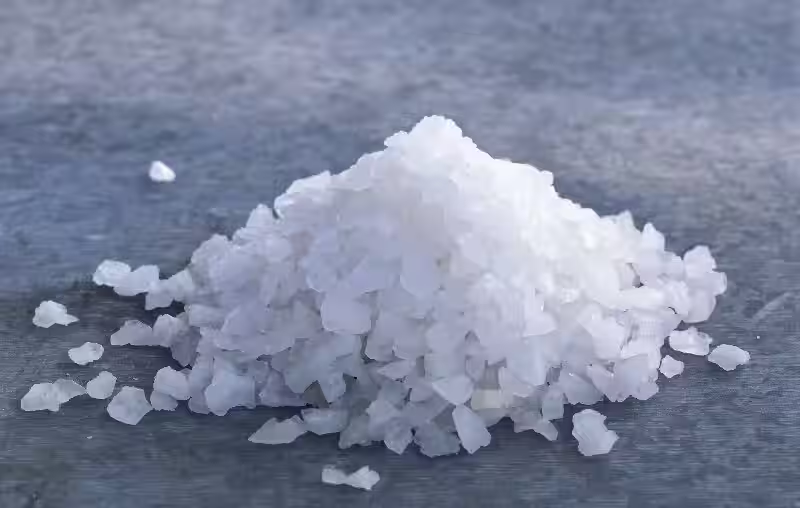
Ethylenebis(stearamide), often abbreviated as EBS, is a waxy white solid, also available as a powder or beads, with the chemical formula (CH₂NHC(O)C₁₇H₃₅)₂. Its synthesis involves a relatively straightforward reaction between ethylenediamine and stearic acid. This seemingly simple reaction yields a compound with surprisingly diverse and valuable properties.
The long hydrocarbon chains from the stearic acid component impart significant hydrophobic character to the molecule. This, combined with the amide linkages, contributes to EBS's unique lubricating and release agent properties. The molecule's structure allows it to effectively reduce friction between surfaces, making it invaluable in various manufacturing processes.
EBS's most prominent application is as a release agent. In industries like plastics manufacturing and powder metallurgy, EBS prevents materials from adhering to molds or processing equipment. This significantly improves efficiency by simplifying the removal of finished products, reducing waste, and minimizing downtime. Its use is particularly critical in processes involving high temperatures and pressures where sticking can lead to substantial losses.
EBS in Plastics Processing: More Than Just a Release Agent
Beyond its role as a release agent, EBS finds extensive use as an additive in plastic applications. Its incorporation into plastic formulations acts as both an internal and external lubricant, improving the flow properties of the molten polymer. This translates into smoother production runs, reduced wear and tear on machinery, and improved overall process efficiency.
Furthermore, EBS contributes to the color stability of the final plastic product and inhibits polymer degradation. These properties extend the lifespan and maintain the superior quality of plastic goods, contributing to enhanced durability and consumer satisfaction. Its ability to act as a dispersing agent further enhances the homogeneous distribution of fillers and other additives within the plastic matrix, ensuring a consistent and high-quality final product.
The antistatic properties of EBS also contribute significantly to its industrial value, particularly in applications involving electrically sensitive materials like wiring and electronics. By reducing the accumulation of static electricity, EBS enhances workplace safety and prevents potential damage caused by electrostatic discharge (ESD). This aspect adds an extra layer of benefit to its already impressive list of advantages.
Exploring Other Ethylenebis Derivatives
While EBS is a prime example of the usefulness of ethylenebis compounds, many other derivatives exist, each with its unique characteristics and applications. The versatility of the ethylenediamine backbone allows for the attachment of various functional groups, leading to a wide range of chemical and physical properties. This opens up possibilities for tailoring the compound to specific needs.
For instance, consider ethylenebis(oxyethylene) dihexanoate (EBOEDH). The "dihexanoate" portion indicates the presence of two hexanoic acid moieties, contributing to its lipophilic nature. The "ethylenebis(oxyethylene)" part suggests a flexible, slightly polar central linker. This combination of hydrophobic and polar characteristics suggests applications in areas like surfactants, emulsifiers, plasticizers, and lubricants. The specific properties of EBOEDH, however, would require further investigation, likely using databases like PubChem to gain a complete understanding.
Tailoring Ethylenebis Compounds: The Future of Material Science
The research and development efforts in the field of ethylenebis compounds are ongoing, constantly exploring new derivatives and applications. The ability to tailor the chemical structure by modifying the functional groups attached to the central ethylenediamine backbone allows for the precise tuning of properties. This opens exciting possibilities for developing new materials with enhanced performance characteristics in diverse fields.
Researchers are exploring novel applications of ethylenebis compounds, including their use in advanced materials, pharmaceuticals, and even cosmetics. The possibilities seem limitless, driven by the inherent versatility of this fundamental chemical structure.
Conclusion: The Enduring Importance of Ethylenebis Compounds
Ethylenebis compounds, notably EBS and its derivatives, have proven their worth as indispensable components in various industrial processes. Their unique combination of properties—lubrication, release, dispersion, and antistatic capabilities—makes them crucial for enhancing efficiency, improving product quality, and ensuring workplace safety. As research continues to explore new derivatives and applications, the role of ethylenebis compounds in modern manufacturing and material science will only continue to grow. The understanding of their chemical structure and their consequent properties is key to unlocking their full potential and driving innovation across various sectors.
Frequently Asked Questions about Ethylene Bis(Stearamide) (EBS)
What is Ethylene Bis(Stearamide) (EBS)?
Ethylene Bis(Stearamide) (EBS) is a waxy white solid, also available as a powder or beads, with the chemical formula (CH₂NHC(O)C₁₇H₃₅)₂. It's a versatile organic compound synthesized from the reaction of ethylenediamine and stearic acid. It's characterized by its low toxicity and possesses excellent lubricating and release properties.
What are the key properties of EBS?
EBS is primarily valued for its:
Lubricity: It acts as an effective lubricant, reducing friction and wear.
Release properties: It prevents materials from sticking to surfaces, making it a crucial release agent in manufacturing.
Dispersing ability: It helps evenly distribute solid components within a matrix, particularly in plastics.
Antistatic properties: It reduces static buildup, improving safety in sensitive applications.
What are the main applications of EBS?
EBS finds widespread use in:
Release agent: In the manufacturing of thermoplastics and powder metallurgy, preventing sticking to molds and equipment.
Plastic additive: Enhancing the processability, flow, color stability, and overall lifespan of plastic products.
Powder metallurgy: Optimizing compaction and sintering processes for improved metal component quality (as detailed by Auborn and Choo, 1993).
Wire production: Reducing static electricity buildup and improving safety.
EBS's lubricating properties create a slippery coating on surfaces, preventing materials from adhering during processing. This facilitates the easy removal of finished products from molds or equipment, streamlining production and reducing waste.
What are the benefits of using EBS in plastics?
In plastics, EBS acts as both an internal and external lubricant, improving processing, reducing wear on machinery, enhancing color stability, inhibiting polymer degradation, and ensuring homogenous distribution of additives for a consistent final product.
Is EBS safe to use?
EBS is characterized by its low toxicity, making it a relatively safe material for industrial applications. However, as with any chemical, appropriate safety precautions should always be followed during handling and processing.
Where can I find more information about EBS?
Further information on EBS can be sought from scientific literature, material safety data sheets (MSDS) from suppliers, and relevant industry publications. Specific studies, such as that by Auborn and Choo (1993) regarding its use in powder metallurgy, can provide detailed insights into its performance in specific applications.