Understanding Dimethylbenzylamine: Applications and Properties
Understanding Dimethylbenzylamine: Applications and Properties
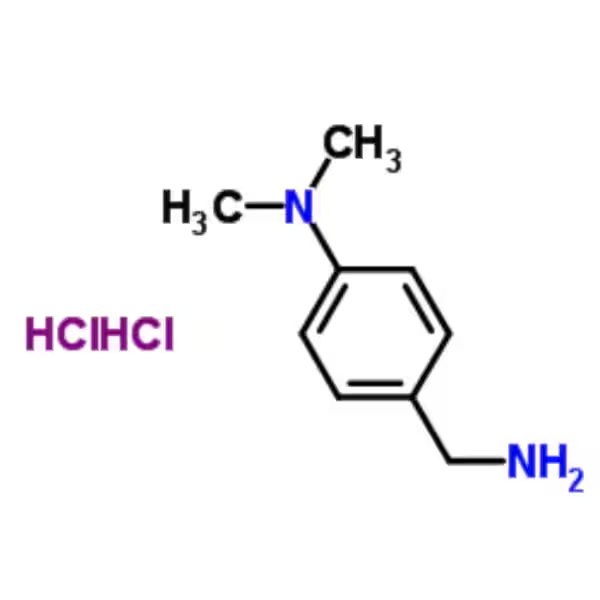
Dimethylbenzylamine (DMBA), a colorless liquid with the chemical formula C₆H₅CH₂N(CH₃)₂, holds a significant place in various industrial and chemical processes. Its unique structure, combining an aromatic benzene ring with a tertiary amine group, gives it a versatile reactivity profile. This article will explore DMBA's properties, synthesis, and diverse applications, highlighting its importance in modern chemistry.
The Structure and Properties of Dimethylbenzylamine
DMBA's structure is pivotal to understanding its behavior. The benzyl group (C₆H₅CH₂) provides a relatively nonpolar component, while the dimethylamino group (-N(CH₃)₂) introduces a polar, basic character. This combination influences its solubility, reactivity, and overall behavior.
The tertiary amine functionality is particularly significant. The nitrogen atom, bonded to three carbons, possesses a lone pair of electrons, making it a weak base. Unlike primary or secondary amines, it cannot form hydrogen bonds with itself, affecting its physical properties like boiling point and solubility. This lack of hydrogen bonding also influences its interactions with other molecules.
The presence of the benzene ring significantly impacts DMBA's reactivity. It allows for potential reactions characteristic of aromatic systems, such as electrophilic aromatic substitution. The dimethylamino group, being electron-donating, directs further reactions to the ortho and para positions on the benzene ring. This directed ortho metalation is a key reaction allowing for the synthesis of a wide variety of DMBA derivatives.
Synthesis of Dimethylbenzylamine
The most common method for synthesizing DMBA is the Eschweiler-Clarke reaction. This reaction typically involves the methylation of benzylamine using formaldehyde and formic acid. This process efficiently converts the primary amine (benzylamine) into the tertiary amine (DMBA). The reaction conditions are relatively mild, making it a practical and efficient synthesis route.
Other synthetic routes may exist, but the Eschweiler-Clarke method provides a balance of efficiency and simplicity, making it the preferred method in many industrial settings. The specific reaction conditions, such as temperature and reaction time, can be optimized to achieve high yields of pure DMBA.
One of the primary applications of DMBA lies in its catalytic activity. Its tertiary amine structure makes it a highly effective catalyst in several polymerization reactions.
Polyurethane Foam Production
DMBA plays a crucial role as a catalyst in the production of polyurethane foams. The tertiary amine group facilitates the reaction between isocyanates and polyols, accelerating the polymerization process and leading to the formation of the characteristic foam structure. It helps control the reaction rate and the final properties of the foam, including its density and rigidity.
Epoxy Resin Curing
Similarly, DMBA functions as a catalyst in the curing of epoxy resins. It accelerates the cross-linking process, influencing the final mechanical properties of the cured resin, such as strength, hardness, and flexibility. The careful selection of DMBA and other catalysts are crucial in achieving the desired properties.
DMBA Reactivity and Derivative Synthesis
Beyond its catalytic applications, DMBA is a valuable reagent for synthesizing various derivatives. Its reactivity stems from both the aromatic ring and the tertiary amine.
Directed Ortho Metalation
A particularly noteworthy reaction is directed ortho metalation (DoM). Treatment of DMBA with strong bases, like butyl lithium, allows for the introduction of various substituents at the ortho position of the benzene ring. This opens up avenues for creating a wide range of DMBA derivatives with the general formula 2-X-C₆H₄CH₂N(CH₃)₂, where X represents a variety of substituents including thioethers, phosphines, and halides, significantly expanding its potential applications.
Quaternary Ammonium Salt Formation
Another important reaction is quaternization with alkyl halides, such as hexyl bromide. This process yields quaternary ammonium salts, [C₆H₅CH₂N(CH₃)₂R]⁺X⁻. These salts find use as phase-transfer catalysts. Phase-transfer catalysts facilitate reactions between reactants in different phases (aqueous and organic), improving reaction efficiency and product selectivity. They act as a bridge between the two phases, carrying reactants from one phase to another, where the reaction can proceed more efficiently.
Like many organic chemicals, DMBA requires careful handling. While its toxicity is not extensively documented in readily available sources, general safety precautions for handling amines should be observed. This includes proper ventilation, use of personal protective equipment (PPE), and avoidance of skin or eye contact. Refer to relevant safety data sheets (SDS) before handling DMBA and always follow appropriate laboratory safety protocols.
Dimethylbenzylamine is a versatile compound with widespread applications across various industrial and chemical processes. Its catalytic activity in polyurethane foam and epoxy resin production is particularly important. Furthermore, its unique reactivity, including directed ortho metalation and its ability to form quaternary ammonium salts, allows for the synthesis of numerous derivatives with diverse applications. Continued research into DMBA’s reactivity and potential uses will undoubtedly reveal further applications for this valuable chemical.
Frequently Asked Questions about Dimethylbenzylamine (DMBA)
What is Dimethylbenzylamine (DMBA)?
Dimethylbenzylamine (DMBA), with the chemical formula C₆H₅CH₂N(CH₃)₂, is a colorless liquid organic compound. It consists of a benzyl group (C₆H₅CH₂) attached to a dimethylamino group (N(CH₃)₂). Its key characteristic is its tertiary amine functionality.
What are the primary applications of DMBA?
DMBA's main applications stem from its ability to act as a catalyst. It is significantly used in the production of polyurethane foams and epoxy resins. In these processes, the tertiary amine group facilitates polymerization or cross-linking reactions, influencing the final product's properties and structure.
How is DMBA synthesized?
A common synthetic route for DMBA is the Eschweiler-Clarke reaction, which utilizes benzylamine as a starting material. This method offers a relatively straightforward and efficient approach to DMBA production.
DMBA demonstrates reactivity typical of tertiary amines. It undergoes directed ortho metalation with strong bases like butyl lithium, enabling the introduction of various substituents at the ortho position of the benzene ring. This opens avenues for synthesizing derivatives with expanded applications. Additionally, DMBA can undergo quaternization with alkyl halides to form quaternary ammonium salts, useful as phase-transfer catalysts.
What are the advantages of using DMBA as a catalyst?
DMBA's catalytic activity contributes to efficient and controlled polymerization in the production of materials like polyurethane foams and epoxy resins. Its use can lead to improved reaction rates and desired final product properties.
What are some examples of DMBA derivatives and their uses?
Ortho-metalation of DMBA allows for the synthesis of derivatives with substituents (X) at the ortho position of the benzene ring (general formula: 2-X-C₆H₄CH₂N(CH₃)₂). Examples of X include thioethers (SR) and phosphines (PR₂). These derivatives offer expanded potential applications beyond the primary catalytic roles of DMBA. Quaternization with alkyl halides yields quaternary ammonium salts, which are valuable phase-transfer catalysts.
What safety precautions should be taken when handling DMBA?
As with any chemical, appropriate safety measures should be followed when handling DMBA. Detailed safety data sheets (SDS) should be consulted for specific handling, storage, and disposal procedures. This would include appropriate personal protective equipment (PPE) like gloves and eye protection, and working in a well-ventilated area.
Where can I find more information about DMBA?
Further information on DMBA's properties, applications, and safety can be found in scientific literature databases (e.g., SciFinder, Reaxys), chemical supplier catalogs, and safety data sheets (SDS) provided by manufacturers and suppliers.