Understanding Triacetin: Uses, Safety, and Applications
Understanding Triacetin: Uses, Safety, and Applications
Triacetin, also known as glyceryl triacetate, is a fascinating chemical compound with a surprisingly wide range of applications. This colorless, viscous liquid, with its distinctive mildly sweet taste at low concentrations, plays a significant role in various industries, from food production to cutting-edge medical research. This article will delve into the multifaceted nature of triacetin, exploring its properties, uses, and safety profile.
Triacetin’s Chemical Properties and Basic Structure
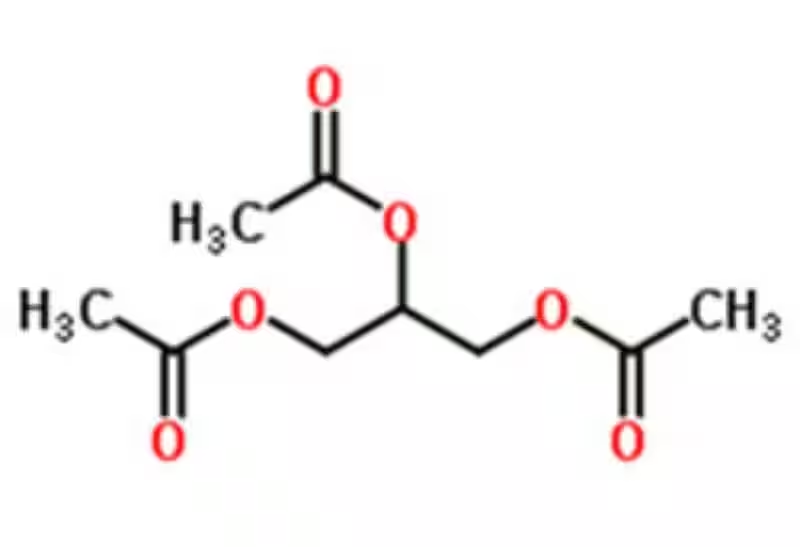
Triacetin, with its chemical formula C₃H₅(OCOCH₃)₃, is classified as a triglyceride. This means it's a triester formed from the reaction of glycerol (a three-carbon alcohol) and three molecules of acetic acid (vinegar's main component). This simple yet crucial chemical structure is responsible for many of triacetin's unique properties.
Its high boiling point and low melting point make it a versatile solvent, capable of dissolving a variety of substances. This, combined with its lack of odor, makes it an ideal additive in many products where a neutral profile is desired. However, it's important to note that while mildly sweet at low concentrations (below 500 ppm), triacetin becomes bitter at higher levels, a factor to consider in its application.
Triacetin's Role as a Food Additive
Triacetin has gained recognition as a versatile food additive, boasting the E number E1518 (and Australian code A1518). Its primary function in food products is as a solvent for flavorings, enabling the even distribution of tastes throughout a food item. Beyond this, it also acts as a humectant, helping retain moisture and preventing dryness, thus extending the shelf life and improving the texture of various food products.
The FDA's Generally Recognized As Safe (GRAS) status, granted in 1975, underscores the safety profile of triacetin for consumption. This designation, based on the Select Committee on GRAS Substances (SCOGS) opinion, solidifies triacetin's place as a reliable and safe ingredient in the food industry.
Triacetin in Pharmaceuticals and Drug Delivery
The pharmaceutical industry has also embraced triacetin's unique properties. It functions as a humectant, plasticizer, and solvent in many pharmaceutical formulations. Its humectant properties help maintain moisture content in medications, ensuring stability. As a plasticizer, it enhances the flexibility and workability of various materials used in drug delivery systems.
More excitingly, triacetin's potential in advanced drug delivery systems is being actively explored. Studies have demonstrated its efficacy in creating biodegradable phospholipid gels for controlled-release drug administration. For instance, triacetin has shown promise in creating a gel for the controlled release of paclitaxel, a powerful cancer drug. This biodegradable gel allows for the slow, targeted release of the drug directly into cancerous cells, minimizing side effects while maximizing therapeutic efficacy.
Triacetin's Potential Beyond Established Applications
The applications of triacetin are not limited to food and pharmaceuticals. Its potential in emerging fields is significant and holds promise for future innovations. Research is exploring triacetin's use as a fuel additive. Its antiknock properties in gasoline can reduce engine knocking, improving combustion efficiency. Furthermore, it can improve the cold-weather performance and reduce the viscosity of biodiesel, expanding its usability in colder climates.
Another compelling area of research is triacetin's potential as a significant source of dietary energy in artificial food systems for long-duration space missions. Studies suggest that triacetin could safely contribute a substantial portion (over half) of an individual's daily caloric intake, making it a vital component of life support systems in space travel.
Synthesis and Safety Profile of Triacetin
Triacetin's synthesis is remarkably straightforward and cost-effective. Historically produced from glycerol and acetic acid, modern methods often involve reacting acetic anhydride with glycerol, frequently catalyzed by sodium hydroxide or a cobalt(II) Salen complex. These methods often achieve yields approaching 99%, demonstrating the efficiency of modern production techniques.
From a safety perspective, triacetin has a strong track record. Beyond the FDA's GRAS status, animal studies have indicated that repeated inhalation exposure to triacetin over short periods is non-toxic. This robust safety profile, alongside its diverse applications and efficient synthesis, contributes to triacetin's attractiveness as a versatile chemical compound.
Conclusion: Triacetin – A Versatile Compound with a Bright Future
In conclusion, triacetin is a multifaceted chemical compound with established uses in various sectors and considerable potential in emerging fields. Its role as a food additive, pharmaceutical ingredient, and its potential in drug delivery systems, fuel technology, and long-duration space missions highlights its versatility. Given its relatively simple and inexpensive synthesis, coupled with its recognized safety profile, triacetin is poised to play an increasingly significant role in various technological advancements and industrial applications in the years to come. Its continued research and development promise even more exciting applications in the future.
Triacetin: Frequently Asked Questions
What is triacetin?
Triacetin, also known as glyceryl triacetate, is a triglyceride – a naturally occurring ester composed of glycerol and three acetic acid molecules. Its chemical formula is C₃H₅(OCOCH₃)₃. It's a colorless, viscous liquid with a high boiling point, low melting point, and a mildly sweet taste at low concentrations.
What are the common uses of triacetin?
Triacetin has a wide range of applications. It's a common food additive (E number E1518, Australian code A1518) used as a solvent in flavorings and a humectant (a substance that retains moisture). It also serves as a humectant, plasticizer, and solvent in various pharmaceutical formulations.
What are some emerging applications of triacetin?
Triacetin's potential extends beyond its established uses. Its plasticizing properties are being explored in biodegradable drug delivery systems, specifically in creating gels for controlled drug release. It's also being investigated as a fuel additive, potentially improving gasoline's anti-knock properties and biodiesel's cold-weather performance. Furthermore, research suggests it could be a significant source of dietary energy in artificial food systems for long-duration space missions.
Yes, triacetin is generally considered safe for consumption. The U.S. Food and Drug Administration (FDA) has granted it Generally Recognized As Safe (GRAS) status. Animal studies have also shown it to be non-toxic following repeated short-term inhalation exposure.
How is triacetin synthesized?
Triacetin can be synthesized relatively easily and inexpensively. Traditional methods involved reacting glycerol and acetic acid. Modern methods utilize acetic anhydride and glycerol, often catalyzed by sodium hydroxide or a cobalt(II) Salen complex, resulting in high yields.
What is the taste and odor of triacetin?
Triacetin is odorless. Its taste is mildly sweet at low concentrations (below 500 ppm), but becomes bitter at higher concentrations.
Where can I find triacetin?
Triacetin is available from various chemical suppliers. The specific availability and pricing will depend on the quantity needed and the supplier.
What is the role of triacetin in drug delivery systems?
Triacetin's plasticizing properties make it useful in creating biodegradable gels for controlled drug release. Studies have shown its effectiveness in a biodegradable phospholipid gel for the controlled delivery of the cancer drug paclitaxel. This allows for sustained drug delivery directly to cancerous cells.
What is triacetin's role as a fuel additive?
Triacetin can act as an antiknock agent in gasoline, reducing engine knocking. It can also improve the cold-weather performance and viscosity of biodiesel.
What is triacetin's potential in space travel?
Research suggests triacetin could be a valuable source of dietary energy in artificial food systems designed for long-duration space missions, potentially contributing over half of an individual's daily caloric intake.