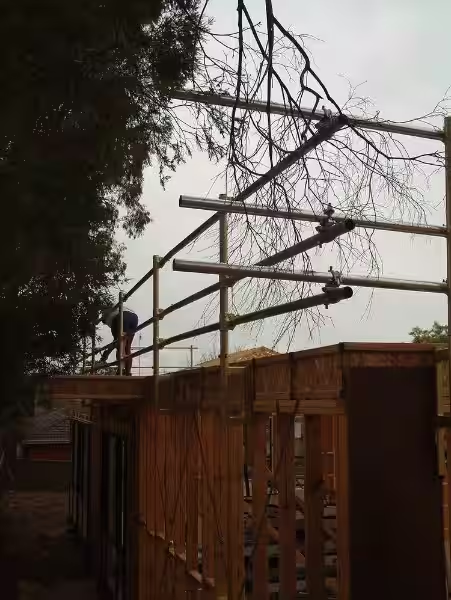
Understanding 1910 Fall Protection: Navigating OSHA's Complexities
Understanding 1910 Fall Protection: Navigating OSHA's Complexities
Falls are a leading cause of workplace injuries and fatalities. Understanding and complying with OSHA's fall protection regulations is paramount for maintaining a safe work environment. This article will clarify the often-misunderstood aspects of 1910 fall protection, focusing on the nuances of OSHA standard 1910.28 and its implications for employers and employees.
OSHA Standard 1910.28 and the Residential Roof Exception
OSHA standard 1910.28 mandates fall protection for employees working at heights. This includes a variety of methods, such as guardrails, safety nets, and personal fall arrest systems. However, a crucial exception exists within this standard, specifically 1910.28(b)(1)(ii), which addresses situations on residential roofs where traditional fall protection systems are deemed infeasible or create a greater hazard.
This exception doesn't grant a free pass to disregard fall protection altogether. Instead, it shifts the burden to the employer to demonstrate, with concrete evidence, that using standard fall protection methods is genuinely impractical and would, counterintuitively, increase risk. This is a high bar to clear; mere inconvenience or cost concerns are insufficient justification.
For example, imagine a steep, narrow, complex residential roof where erecting guardrails or deploying a safety net is practically impossible without causing structural damage or creating additional hazards. This might be a situation where the exception could apply, but only with substantial documented evidence.
Developing an Alternative Fall Protection Plan
When the 1910 fall protection standard's traditional methods are deemed infeasible, the employer must develop a comprehensive alternative plan. This plan isn't a simple statement; it needs to be a detailed, site-specific strategy that addresses the unique hazards of the work environment. This plan must adhere to the requirements outlined in 29 CFR 1926.502(k), which likely includes these key elements:
Hazard Identification: A thorough assessment of all potential fall hazards specific to the residential roof.
Preventative Measures: Specific, detailed steps to mitigate identified fall hazards.
Emergency Procedures: A clear plan for responding to falls or other emergencies.
Employee Training: Adequate training on the procedures and equipment used in the alternative plan.
This alternative plan needs to be rigorously documented and readily available on-site. It's not enough to simply say, "we're using an alternative plan"; the plan itself must be meticulous.
The Importance of Employee Training
The effectiveness of any fall protection plan, standard or alternative, hinges on proper employee training. Employees must understand the hazards they face, the procedures they should follow, and how to use any equipment correctly. This training must meet the criteria of 29 CFR 1926.503(a) and (c).
This includes both theoretical knowledge and practical skills training. Employees need to understand the rationale behind the procedures, not just the steps to follow. Regular refresher training is also crucial to ensure that employees maintain their skills and knowledge. Inadequate training negates the effectiveness of the fall protection plan and significantly increases the risk of accidents. Detailed records of all training sessions must be kept for OSHA compliance.
Beyond 1910: Understanding OSHA’s Fall Protection Standards in General Industry and Construction
While 1910 fall protection is crucial, it's only one piece of the larger OSHA puzzle. The agency's fall protection standards (29 CFR 1910 and 1926) are frequently misinterpreted, leading to avoidable workplace accidents. A critical source of confusion lies in differentiating between the general industry standard (1910) and the construction standard (1926).
While there's some overlap, they aren't interchangeable. Standard 1910 applies to general workplaces, maintenance, and most non-construction operations. In contrast, 1926 governs construction, including roofing work. The correct standard depends heavily on the nature of the task.
Common Misinterpretations and Clarifications
Many misunderstandings arise regarding fall protection height requirements. There's no single universal "6-foot rule." OSHA mandates fall protection at 4 feet for general industry and 6 feet for construction. Furthermore, protection is mandatory regardless of height when working near dangerous equipment or unguarded edges.
The construction exemption (29 CFR 1926.500(a)(1)) adds another layer of complexity. This exemption from fall protection applies only to inspections, investigations, or assessments before construction starts or after it's completed. This doesn't extend to general industry work, even if performed on a construction site. Prolonged inspections near fall hazards necessitate fall protection.
Finally, understanding the nuances of low-slope roofs is crucial. 29 CFR 1926.501(b)(10) mandates fall protection on low-slope roofs at 6 feet or more above lower levels. These seemingly small distinctions can have major consequences for workplace safety.
By understanding the specific requirements of 1910 fall protection and the broader context of OSHA's fall protection standards, employers can create safer work environments, reducing the risks of falls and protecting their employees. Remember, safety is not optional; it's a legal and moral obligation.
1910 Fall Protection FAQs
Here are some frequently asked questions regarding OSHA's 1910 fall protection standards, focusing on the nuances of 1910.28(b)(1)(ii) and related regulations.
What is OSHA Standard 1910.28?
OSHA Standard 1910.28 mandates fall protection and falling object protection for employees in general industry settings. It outlines various methods of fall protection, including guardrails, safety nets, and personal fall arrest systems. Crucially, it also addresses situations where these standard methods are infeasible or would create a greater hazard.
What does 1910.28(b)(1)(ii) say about fall protection on residential roofs?
This section provides a narrow exception to the general rule of mandatory fall protection. If an employer can demonstrate that using standard fall protection systems (guardrails, safety nets, or personal fall arrest systems) is infeasible or would create a greater hazard on a residential roof, they may implement an alternative plan. However, this requires substantial justification and is not easily met. Simple inconvenience or cost are insufficient reasons.
What constitutes "infeasible" or a "greater hazard" under 1910.28(b)(1)(ii)?
The employer bears the burden of proof. They must provide concrete evidence demonstrating that implementing any of the standard fall protection methods is genuinely impossible or would increase the risk of falls or other injuries. This requires more than just claiming infeasibility; detailed justification is necessary.
If standard fall protection is deemed infeasible, what must the employer do?
The employer must develop and implement a comprehensive alternative fall protection plan that meets the requirements of 29 CFR 1926.502(k). This plan must detail fall hazards, preventative measures, and emergency procedures. It cannot be a generic plan; it must be site-specific and rigorously detailed. Furthermore, employees must receive specific training compliant with 29 CFR 1926.503(a) and (c).
What kind of training is required for employees working under an alternative fall protection plan?
Training must meet the criteria of 29 CFR 1926.503(a) and (c). This ensures workers understand the specific procedures and potential risks associated with the alternative plan, as these may be different from and potentially more hazardous than standard fall protection methods. Inadequate training is unacceptable.
What is the difference between OSHA standards 1910 and 1926 regarding fall protection?
Standard 1910 applies to general industry, while 1926 applies to construction. While there is overlap, they are not interchangeable. New construction, major repairs, and renovations typically fall under 1926. Routine maintenance often falls under 1910. Determining the appropriate standard depends on the specific nature of the work. Even renovations can be confusing, but OSHA's construction standards apply to "work for construction, alteration, and/or repair."
Is there a universal 6-foot rule for fall protection?
No. The required fall protection height varies. For general industry (1910), fall protection is typically mandated at 4 feet. For construction (1926), it's usually 6 feet. However, fall protection is also required regardless of height when working near dangerous equipment. For low-slope roofs, 29 CFR 1926.501(b)(10) mandates fall protection at 6 feet or more.
What about the construction exemption (29 CFR 1926.500(a)(1))?
This exemption applies to inspections, investigations, or assessments before construction begins or after it's completed. It does not apply to general industry work, such as HVAC maintenance on a roof, or to prolonged periods of exposure to fall hazards during inspections. If an inspection requires prolonged work near a fall hazard, fall protection is needed.
Where can I find more detailed information on OSHA fall protection standards?
You can find comprehensive information on the OSHA website (osha.gov). Search for "1910.28," "1926.500," "1926.501," "1926.502," and "1926.503" to access the relevant standards and interpretations. Consult with a safety professional for clarification on specific situations.