Understanding Sulfuric Acid Oleum: Properties, Production, and Applications
Understanding Sulfuric Acid Oleum: Properties, Production, and Applications
Sulfuric acid oleum, also known as fuming sulfuric acid, is a fascinating and powerful chemical compound with a rich history and diverse applications. While its name might sound intimidating, understanding its properties and uses is crucial for appreciating its role in various industries. This article will delve into the intricacies of oleum, exploring its composition, production methods, safety considerations, and prominent applications.
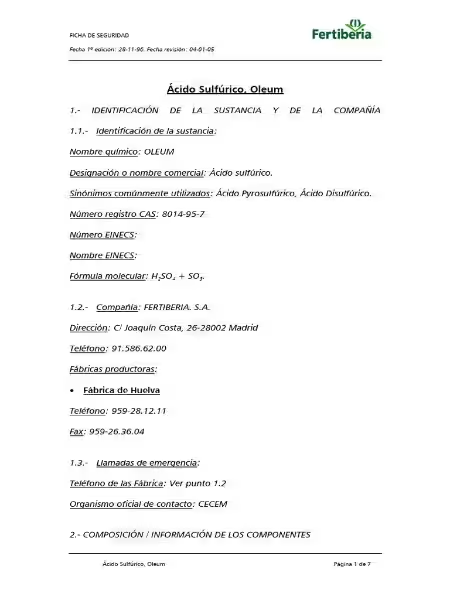
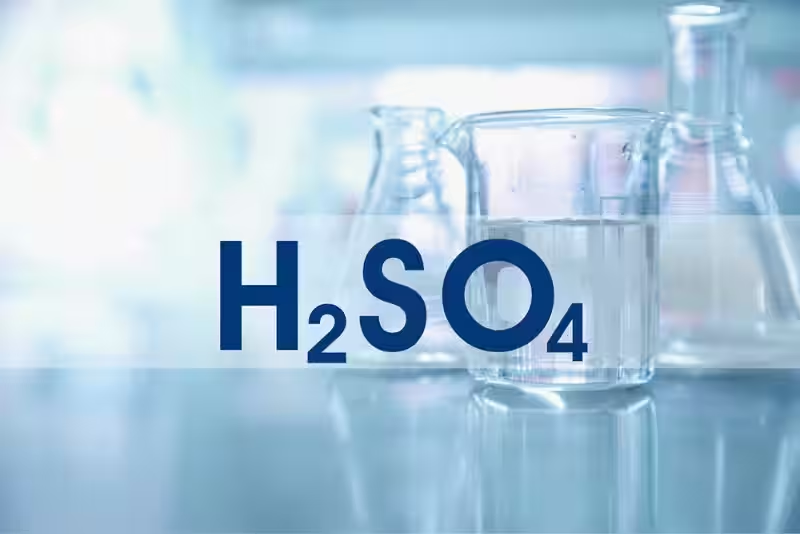
Oleum is not simply concentrated sulfuric acid; it’s a solution of sulfur trioxide (SO₃) dissolved in sulfuric acid (H₂SO₄). This seemingly simple difference profoundly impacts its properties and applications. The composition of oleum can be expressed in several ways, most commonly as ySO₃·H₂O (where y represents the molar mass of SO₃) or, more conveniently, as H₂SO₄·xSO₃ (where x represents the molar amount of free SO₃). The free SO₃ content is often expressed as a percentage, frequently exceeding 100% sulfuric acid when expressed as a percentage of H₂SO₄.
This excess SO₃ is what gives oleum its characteristic "fuming" nature and enhanced reactivity. A crucial component within oleum is disulfuric acid (H₂S₂O₇), also known as pyrosulfuric acid. This compound is solid at room temperature and rarely used in its pure form, being more commonly found as a constituent of oleum. The presence of disulfuric acid and free SO₃ is largely responsible for the properties and reactivity of oleum that set it apart from concentrated sulfuric acid.
Production of Sulfuric Acid Oleum
The primary method for producing sulfuric acid oleum is the contact process. This highly efficient industrial process involves the oxidation of sulfur to sulfur trioxide (SO₃), followed by the careful dissolution of this SO₃ into concentrated sulfuric acid. This contrasts sharply with the now-obsolete lead chamber process, which could not efficiently produce concentrated sulfuric acid or SO₃ directly due to significant corrosion issues.
Historically, oleum was produced via a less efficient method involving the distillation of iron sulfates in Nordhausen, Germany – hence the historical name "Nordhausen acid." The contact process, on the other hand, offers precise control over the oleum's composition and significantly higher production yields, making it the dominant method used today.
Oleum's unique properties make it invaluable in several industries. One of its most significant roles is in the production of sulfuric acid itself. Directly adding SO₃ to water is highly inefficient and dangerous due to the formation of hazardous sulfuric acid mists. However, dissolving SO₃ into concentrated sulfuric acid creates oleum, which can then be safely diluted to produce highly concentrated sulfuric acid. This is particularly crucial because sulfuric acid above 98.3% concentration spontaneously decomposes into SO₃ and water; oleum solves this by shifting the equilibrium.
Transportation and Handling
Additionally, oleum's high viscosity, and even solid state at certain concentrations, makes it a safer and more cost-effective transport medium for sulfuric acid than liquid H₂SO₄, particularly for large-scale transportation by rail. However, this higher viscosity presents its own set of challenges. Careful handling and temperature control are vital to prevent overheating and pressure buildup. A notable example is the 1993 Richmond, California incident where overheating of an oleum shipment led to the release of SO₃, forming a hazardous sulfuric acid mist, emphasizing the need for stringent safety protocols. The freezing point of oleum varies significantly and unpredictably with concentration, adding further complexity to its safe handling.
Organic Chemistry Applications
In organic chemistry, oleum acts as a potent dehydrating and nitrating agent, exceeding nitric acid in sulfuric acid in its effectiveness. Its strong dehydrating properties are evident in its exothermic reaction with sugars, leaving behind almost pure carbon. It plays a prominent role in the production of explosives, creating anhydrous mixtures of nitric and sulfuric acids required for processes such as trinitrotoluene (TNT) production. Although not needed for the synthesis of all explosives (e.g., RDX), its ability to remove water from commercial-grade nitric acid is crucial in many explosive manufacturing processes, preventing undesired side reactions. A prime example of its use is in the secondary nitration of nitrobenzene, where its superior strength compared to other nitrating agents is essential for efficient production.
Other uses of Oleum
Beyond its major applications in sulfuric acid production and organic chemistry, oleum finds niche uses in various other industrial processes. Its strong dehydrating capabilities make it suitable for specific drying processes in certain industries. Furthermore, its properties as a strong sulfonating agent have applications in specialized chemical syntheses.
Working with sulfuric acid oleum requires strict adherence to safety protocols. Its corrosive nature necessitates the use of appropriate personal protective equipment (PPE), including chemical-resistant gloves, goggles, and lab coats. Proper ventilation is crucial to prevent exposure to potentially harmful fumes. In the case of spills or accidental exposure, immediate action, including appropriate first aid and cleanup procedures, is necessary. Remember, always consult the relevant safety data sheets (SDS) before handling oleum. Its reactivity and potential for hazardous reactions emphasize the need for careful and responsible handling.
In conclusion, sulfuric acid oleum, despite its potentially hazardous nature, is a crucial chemical compound with widespread applications across various industries. Understanding its properties, production methods, and safety requirements is paramount for its safe and effective utilization.
What is oleum?
Oleum, also known as fuming sulfuric acid, is a solution of sulfur trioxide (SO₃) in sulfuric acid (H₂SO₄). Its composition can be expressed in different ways, often as ySO₃·H₂O or H₂SO₄·xSO₃, reflecting the molar amounts of SO₃ and H₂SO₄. It's usually characterized by its free SO₃ content, often expressed as a percentage exceeding 100% sulfuric acid. A key component is disulfuric acid (H₂S₂O₇, or pyrosulfuric acid), which is solid at room temperature but rarely used in its pure form.
How is oleum produced?
Oleum is primarily produced through the contact process, where sulfur is oxidized to SO₃, which is then dissolved in concentrated H₂SO₄. This method contrasts with the obsolete lead chamber process, which couldn't produce highly concentrated H₂SO₄ or SO₃ due to corrosion issues. Historically, oleum was also made by distilling iron sulfates.
Why is oleum used in sulfuric acid production?
Adding SO₃ directly to water is inefficient and dangerous due to the formation of hazardous mists. Oleum provides a solution: SO₃ is dissolved in concentrated H₂SO₄ to form oleum, which can then be safely diluted to create more concentrated sulfuric acid. This is important because sulfuric acid above 98.3% concentration spontaneously decomposes into SO₃ and water; oleum shifts this equilibrium.
What are the safety concerns associated with handling oleum?
Oleum's high viscosity, and sometimes solid state at room temperature, makes it a safer transport medium for sulfuric acid than liquid H₂SO₄, especially by rail. However, it requires extremely careful handling to prevent overheating and pressure build-up, as demonstrated by past incidents. The freezing point of oleum is highly variable and depends on concentration, adding to handling challenges. Although less corrosive to metals than aqueous sulfuric acid, careful handling is still paramount.
What are the applications of oleum in organic chemistry and other industries?
In organic chemistry, oleum acts as a powerful, corrosive reagent. Its strength exceeds that of nitric acid in sulfuric acid, making it useful in reactions like the secondary nitration of nitrobenzene. It's also crucial in explosives manufacturing, creating anhydrous mixtures of nitric and sulfuric acids needed for processes such as trinitrotoluene (TNT) production. While not essential for all explosives, its ability to remove water from commercial-grade nitric acid prevents unwanted side reactions. Its strong dehydrating properties are evident in its exothermic reaction with sugars, leaving behind nearly pure carbon.
What is the difference between oleum and sulfuric acid?
Sulfuric acid (H₂SO₄) is a pure compound, while oleum is a solution of sulfur trioxide (SO₃) dissolved in sulfuric acid. This means oleum has a higher concentration of SO₃ than pure sulfuric acid and possesses different properties, such as higher viscosity and a variable freezing point. The increased SO₃ content makes oleum a more efficient way to transport and handle high concentrations of "sulfuric acid" components.
What are the risks of direct SO3 addition to water?
Direct addition of SO₃ to water is highly dangerous and inefficient due to the formation of a fine mist of sulfuric acid. This mist is difficult to contain and poses a significant inhalation hazard. The exothermic nature of the reaction further complicates safe handling.
How does oleum's composition affect its properties?
The composition of oleum, specifically the amount of free SO₃ present, directly affects its properties like viscosity, freezing point, and reactivity. Higher SO₃ content leads to a higher viscosity and a more complex freezing point behavior. The reactivity also increases with higher SO₃ content.