Understanding Kalium Ferricyanide: Uses, Safety, and Applications
Understanding Kalium Ferricyanide: Uses, Safety, and Applications
Kalium ferricyanide, also known as potassium ferricyanide, is a fascinating chemical compound with a surprisingly wide range of applications. Despite its somewhat intimidating name, understanding its properties and uses is simpler than you might think. This article will delve into the world of kalium ferricyanide, exploring its properties, applications, and safety considerations.
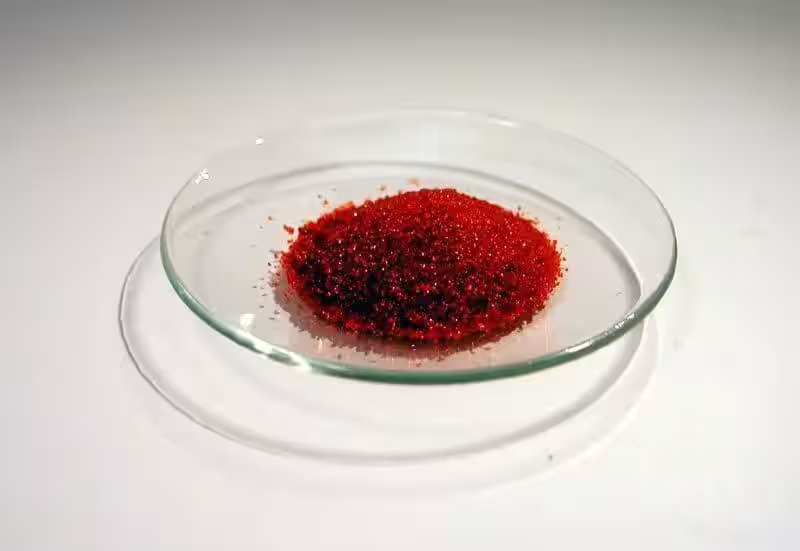
Kalium ferricyanide (K₃[Fe(CN)₆]) is a bright red, crystalline salt that readily dissolves in water. Its solution displays a subtle, yet noticeable, green-yellow fluorescence, a characteristic feature that can be helpful in its identification. This striking color and solubility are key to many of its applications.
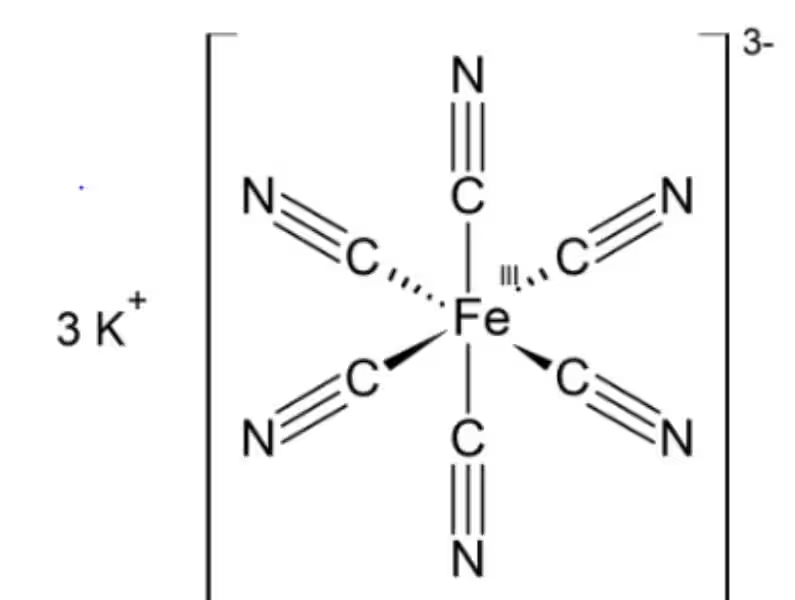
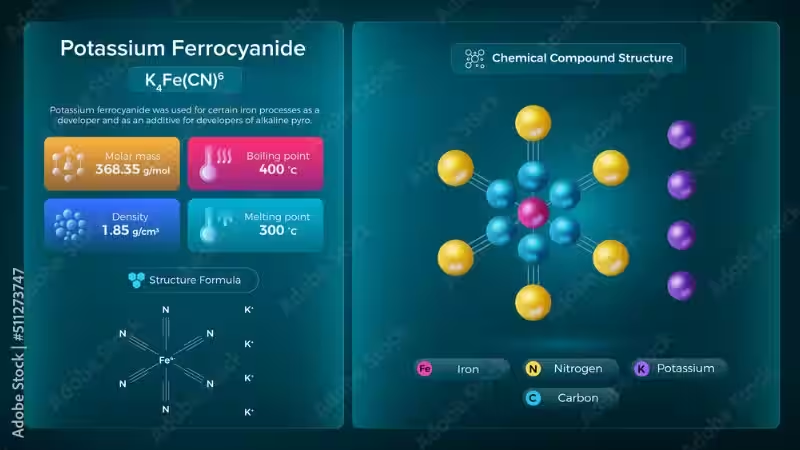
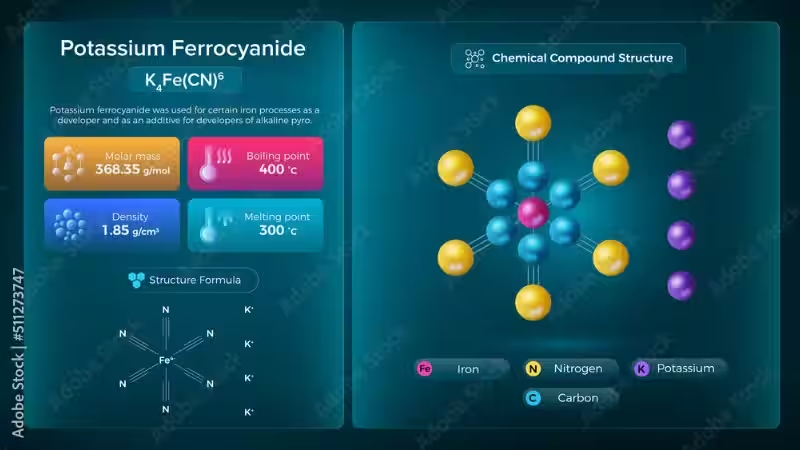
The compound's structure is quite complex at the molecular level. It features an octahedrally coordinated iron(III) ion ([Fe(CN)₆]³⁻) at its core, surrounded by six cyanide ligands. In the solid state, these complex anions are further interconnected with potassium (K⁺) ions, forming a polymeric network. However, this intricate structure disintegrates upon dissolving in water, resulting in the free movement of the [Fe(CN)₆]³⁻ and K⁺ ions. This dissociation is crucial for its reactivity in various chemical processes.
Industrial Production and Discovery
First discovered in 1822, kalium ferricyanide isn't found naturally in significant quantities; it's primarily produced industrially. The most common method involves oxidizing potassium ferrocyanide (K₄[Fe(CN)₆]) using chlorine gas. This oxidation process converts the iron(II) in ferrocyanide to iron(III), resulting in the formation of the ferricyanide ion. The precise conditions and subsequent purification steps are crucial for obtaining a high-purity product suitable for various applications.
Applications of Kalium Ferricyanide
The versatility of kalium ferricyanide is evident in its widespread use across numerous fields. Its unique properties make it valuable in diverse applications, from photography to analytical chemistry.
Historically, kalium ferricyanide played a significant role in photography and blueprint making. It's a mild oxidizing agent, useful in bleaching processes to adjust the density of photographic images. It was, and to a much lesser extent still is, a key component in cyanotype printing and Farmer's reducer (a solution also containing sodium thiosulfate used to lighten photographic negatives and prints). While safer alternatives are now preferred for environmental reasons, its historical significance remains undeniable.
Analytical Chemistry and Biosensing
Kalium ferricyanide's redox properties are exploited extensively in analytical chemistry. It's a vital component of ferroxyl indicator solution (along with phenolphthalein), used to detect ferrous (Fe²⁺) ions. The reaction produces Prussian blue, a deep-blue precipitate that visibly indicates the presence of Fe²⁺. This is a straightforward and reliable qualitative test.
Furthermore, its ability to act as an electron transfer agent has made it invaluable in amperometric biosensors. Devices like blood glucose meters often rely on such sensors, where the redox reactions involving kalium ferricyanide generate measurable electrical signals corresponding to the analyte concentration.
Other Industrial and Scientific Uses
Beyond photography and analytical chemistry, kalium ferricyanide finds applications in:
Metallurgy: Hardening of iron and steel, and as a component of Murakami's etchant used in metallography for enhancing contrast in cemented carbides.
Textiles: Dyeing of wool.
Organic Chemistry: A mild oxidizing agent, particularly useful in Sharpless dihydroxylations for catalyst regeneration.
Histology: Detecting ferrous iron in biological tissues, producing Prussian blue (or the chemically identical Turnbull's blue).
Safety Precautions and Handling
While generally considered to have low toxicity causing primarily mild skin and eye irritation, kalium ferricyanide presents a significant hazard under specific conditions. The most crucial safety concern is its reaction with strong acids. Under acidic conditions, particularly with heating, kalium ferricyanide can decompose, releasing highly toxic hydrogen cyanide (HCN) gas. This poses a severe health risk and necessitates careful handling and disposal procedures. Always consult the Safety Data Sheet (SDS) before handling this chemical. Appropriate personal protective equipment (PPE), including gloves, eye protection, and a well-ventilated workspace, should be used at all times. Disposal should follow local regulations and guidelines to prevent environmental contamination. The reaction with concentrated sulfuric acid is different, avoiding the release of hydrogen cyanide due to an alternative reaction pathway.
In conclusion, kalium ferricyanide is a remarkably versatile compound with applications spanning diverse scientific and industrial fields. Understanding its properties and potential hazards is crucial for its safe and effective use. Always prioritize safety and consult the appropriate safety data sheets before undertaking any procedures involving this chemical.
Frequently Asked Questions about Potassium Ferricyanide
What is Potassium Ferricyanide?
Potassium ferricyanide, with the chemical formula K₃[Fe(CN)₆], is a bright red, water-soluble salt. It contains the [Fe(CN)₆]³⁻ ion, where iron is octahedrally coordinated to six cyanide ligands. Its solution shows a slight green-yellow fluorescence. The solid form has a complex polymeric structure that breaks down in water.
How is Potassium Ferricyanide Produced?
It's produced industrially by oxidizing potassium ferrocyanide with chlorine gas.
What are the Applications of Potassium Ferricyanide?
Potassium ferricyanide has a wide range of applications, including:
Photography: Used as a mild bleach in photographic processes like cyanotype printing and Farmer's reducer (a mixture with sodium thiosulfate). Historically used in color film processing, although safer alternatives are now preferred.
Blueprint Drawing: A key component in creating blueprints.
Metalworking: Used in hardening iron and steel, electroplating, and Murakami's etchant (for metallography).
Organic Chemistry: Acts as a mild oxidizing agent, notably in Sharpless dihydroxylations.
Analytical Chemistry: Component of ferroxyl indicator solution (with phenolphthalein) for detecting Fe²⁺ ions, and used to determine the ferric reducing power potential of samples. Also used as an electron transfer agent in amperometric biosensors.
Histology: Used to detect ferrous iron in biological tissues.
Textiles: Used in wool dyeing.
What are the Safety Concerns Associated with Potassium Ferricyanide?
While generally considered to have low toxicity (causing primarily mild skin and eye irritation), potassium ferricyanide poses a significant hazard under strongly acidic conditions. Reaction with strong acids, especially under heating, can release highly toxic hydrogen cyanide gas. Appropriate safety precautions should always be taken during handling and disposal. The reaction with concentrated sulfuric acid is avoided due to alternative hydrolysis and dehydration reactions.
Potassium ferricyanide is considered to have low toxicity, primarily causing mild skin and eye irritation. However, the release of highly toxic hydrogen cyanide gas under strongly acidic conditions makes it a significant hazard if not handled properly.
How Should Potassium Ferricyanide be Stored?
Storage recommendations are not explicitly given in the provided text. Always consult the Safety Data Sheet (SDS) for specific storage instructions.
What is the Chemical Structure of Potassium Ferricyanide?
Potassium ferricyanide contains the [Fe(CN)₆]³⁻ ion, where an iron(III) ion is at the center, octahedrally coordinated to six cyanide (CN)⁻ ligands. The potassium ions (K⁺) are present to balance the charge. The solid structure is more complex, involving a polymeric arrangement of these [Fe(CN)₆]³⁻ units crosslinked with the K⁺ ions.
What is the color of Potassium Ferricyanide?
Potassium Ferricyanide is a bright red compound. Its solutions exhibit a slight green-yellow fluorescence.
Where can I find more detailed information about Potassium Ferricyanide?
A comprehensive Safety Data Sheet (SDS) and further information can be found from chemical suppliers or relevant databases. (Note: I cannot access external websites or databases).


![Understanding K₃[Fe(CN)₆]: Properties, Applications, and Safety of Potassium Ferricyanide](https://laboraprevencion.com/en/wp-content/uploads/k3-fe-cn-6.avif "Understanding K₃[Fe(CN)₆]: Properties, Applications, and Safety of Potassium Ferricyanide")