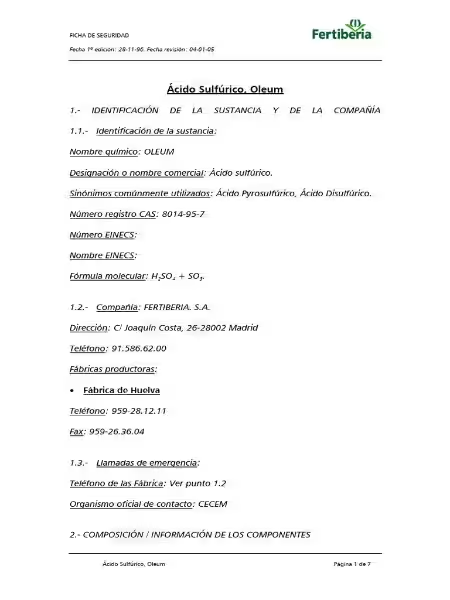
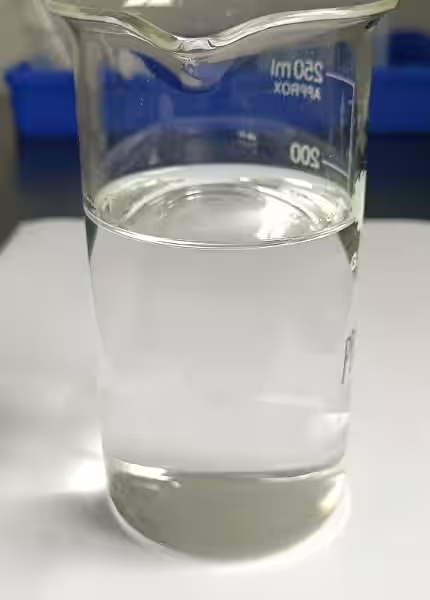
The quest for 100% sulfuric acid is a fascinating journey into the realm of chemistry, highlighting the limitations of achieving absolute purity for even seemingly simple compounds. While commercially available sulfuric acid boasts impressive concentrations, reaching the theoretical 100% mark presents significant practical challenges. This article delves into the reasons behind this, exploring the properties of sulfuric acid and the hurdles in achieving complete dehydration.
Sulfuric acid (H₂SO₄), also known as oil of vitriol, is a highly corrosive mineral acid with an insatiable thirst for water. This inherent characteristic, known as hydroscopy, is the primary reason obtaining 100% sulfuric acid is nearly impossible. Its molecules strongly attract and bind to water molecules from the surrounding environment.
This affinity for water is not simply a surface-level phenomenon; it's a deep-seated chemical property. The sulfuric acid molecules actively seek out and incorporate water molecules into their structure, forming hydrates. This process continues relentlessly, even in seemingly dry conditions, making it extremely difficult to remove the last traces of water. Think of it like trying to drain a sponge completely – no matter how hard you squeeze, some moisture always remains.
The Boiling Point Obstacle and Azeotropes
Another significant obstacle in the pursuit of 100% sulfuric acid lies in its boiling point. As the concentration of sulfuric acid increases, so does its boiling point. However, at high concentrations, a critical phenomenon occurs: an azeotrope forms. An azeotrope is a mixture of two or more liquids whose proportions cannot be changed by simple distillation.
In the case of sulfuric acid and water, this azeotrope boils at a specific temperature and composition, typically around 98.3% sulfuric acid and 1.7% water. This means that attempting to remove the remaining water by boiling the concentrated acid is futile. The solution will continue to boil at the azeotrope's constant composition, preventing the complete removal of water. This is a fundamental limitation imposed by the phase behavior of the sulfuric acid-water system.
As if the hydroscopic nature and azeotrope weren't enough, the thermal decomposition of sulfuric acid adds another layer of complexity. At temperatures exceeding the boiling point of the azeotrope, sulfuric acid starts to break down, releasing sulfur trioxide (SO₃) gas and water.
This decomposition process is not only undesirable but also significantly hinders the attainment of 100% purity. Any attempt to heat the concentrated acid to drive off the remaining water will inevitably lead to this decomposition, resulting in a loss of valuable sulfuric acid and the generation of hazardous SO₃ fumes. The production of these fumes requires strict safety measures and specialized equipment to handle and contain them.
Why 98% Sulfuric Acid is the Standard
Given the difficulties in achieving 100% purity, commercially available sulfuric acid typically reaches concentrations of around 98.3%. This concentration represents the azeotropic composition, and it's the most readily attainable and stable form. The small amount of water present in this commercially available 100 sulphuric acid does not significantly impact its usability in most applications. This makes it the standard for industrial and laboratory uses.
Furthermore, the effort and resources required to pursue the remaining 1.7% would be disproportionate to the negligible benefits gained. The cost and safety risks associated with pushing for complete dehydration outweigh the practical value.
The Practical Implications of 100% Sulfuric Acid
While the theoretical pursuit of 100% sulfuric acid is interesting from a scientific standpoint, its practical significance is limited. The properties of 98% sulfuric acid are more than sufficient for the vast majority of industrial and laboratory applications.
The chemical reactions it participates in are not significantly altered by the presence of a small amount of water. Its corrosive nature, strong dehydrating ability, and oxidizing power remain largely unaffected. Therefore, focusing on the production and handling of high-concentration sulfuric acid (around 98%) is a far more practical and safe approach.
Regardless of the concentration, sulfuric acid demands utmost caution. Its corrosive nature poses significant risks to skin, eyes, and respiratory systems.
Always remember the golden rule of dilution:Always add acid to water, never water to acid. Adding water to concentrated sulfuric acid can result in a violent exothermic reaction, causing dangerous splashing and boiling. Always use appropriate personal protective equipment (PPE), including gloves, goggles, and a lab coat, when handling sulfuric acid.
The quest for 100% sulfuric acid, while scientifically interesting, is practically unattainable due to the acid's inherent hydroscopic nature, the formation of azeotropes with water, and its thermal decomposition at high temperatures. The commercially available 98% sulfuric acid is more than adequate for the vast majority of applications, making the pursuit of absolute purity an unnecessary and potentially hazardous endeavor. Understanding these limitations is essential for safe and effective handling of this powerful chemical.
Frequently Asked Questions about 100% Sulfuric Acid
What is 100% sulfuric acid?
100% sulfuric acid refers to anhydrous sulfuric acid (H₂SO₄), meaning it's completely free of water. However, achieving this state is practically impossible due to sulfuric acid's extreme affinity for water. Commercially available "concentrated" sulfuric acid is typically around 98.3% H₂SO₄.
Why can't 100% sulfuric acid be readily obtained?
The difficulty lies in removing the last traces of water. Sulfuric acid is highly hygroscopic, readily absorbing moisture from the air. Even in dry conditions, it will absorb atmospheric water, preventing complete dryness. Furthermore, at high concentrations, sulfuric acid and water form an azeotrope, a mixture with a constant boiling point that cannot be separated by simple distillation. Finally, heating to remove water causes sulfuric acid to decompose into sulfur trioxide (SO₃) and water, making complete dehydration impossible.
What are the dangers of handling concentrated sulfuric acid?
Concentrated sulfuric acid is extremely corrosive and causes severe chemical and thermal burns upon contact with organic matter, including skin and eyes. Dilution with water is highly exothermic (releases significant heat), potentially causing dangerous splashing and boiling if not done carefully (always add acid to water, never the reverse). Even dilute solutions are harmful. Inhalation of aerosols can lead to serious health problems.
What is the proper way to dilute sulfuric acid?
Always add the acid to the water slowly and carefully, while stirring gently and keeping the mixture in an ice bath to control the heat generated. Never add water to the acid, as this can cause violent boiling and splashing. Appropriate personal protective equipment (PPE), including gloves, goggles, and a lab coat, is essential.
Sulfuric acid has numerous industrial applications, most significantly in fertilizer production (phosphate and ammonium salts). Other uses include chemical synthesis (detergents, resins), mineral processing, oil refining, wastewater treatment, as an electrolyte in lead-acid batteries, and as a catalyst in various industrial processes.
What is the difference between concentrated and dilute sulfuric acid?
"Concentrated sulfuric acid" generally refers to solutions around 98.3% H₂SO₄. Dilute sulfuric acid refers to much weaker solutions, with lower concentrations of H₂SO₄. Dilute solutions are less hazardous than concentrated acid but are still corrosive and require cautious handling. Other grades include battery acid (around 30%).
How is sulfuric acid produced?
The dominant production method is the contact process. This involves burning sulfur to sulfur dioxide, catalytically oxidizing it to sulfur trioxide, and absorbing the trioxide in concentrated sulfuric acid to form oleum, which is then diluted. The older lead chamber process is less common now.
Does the small amount of water in commercially available sulfuric acid affect its use?
The small percentage of water in commercially available (98.3%) sulfuric acid does not significantly affect its functionality in most industrial and laboratory settings. The high concentration is still sufficiently reactive for most purposes.
What are the environmental concerns related to sulfuric acid?
Sulfuric acid is a component of acid rain, formed from atmospheric oxidation of sulfur dioxide. It's also found in acid mine drainage, resulting from the oxidation of sulfide minerals. Occupational exposure to sulfuric acid aerosols can lead to various health problems. International regulations control its trade due to its potential use in illicit drug production.
What first aid measures should be taken in case of sulfuric acid contact?
Immediately flush the affected area with copious amounts of water for at least 15 minutes. Remove contaminated clothing. Seek immediate medical attention. For eye contact, gently hold eyelids open and flush continuously. Never neutralize the acid with a base on the skin.