Understanding Sodium Tetrahydroxyborate: Structure, Synthesis, and Properties
Understanding Sodium Tetrahydroxyborate: Structure, Synthesis, and Properties
Sodium tetrahydroxyborate (NaH₄BO₄ or Na+[B(OH)₄]⁻) is a fascinating compound with a structure more complex than its simple formula suggests. This article delves into its unique characteristics, exploring its crystalline forms, synthesis methods, and reactivity.
Sodium tetrahydroxyborate isn't simply a mixture of sodium oxide, boron oxide, and water, as its elemental ratio might initially imply (Na₂O·B₂O₃·4H₂O). The key to understanding its properties lies in its unique tetrahedral tetrahydroxyborate anion, [B(OH)₄]⁻.
This anion is formed by adding a hydroxide ion (OH⁻) to boric acid (B(OH)₃). This is noteworthy because it involves the addition of a hydroxide ion rather than the typical proton loss seen in acid-base reactions. This subtle difference has significant ramifications for the compound's overall structure and behavior.
The presence of this tetrahedral anion leads to two distinct crystalline forms: monoclinic and orthorhombic. These differences, while subtle at the molecular level, drastically impact the macroscopic properties of the crystal.
Crystalline Forms: Monoclinic vs. Orthorhombic
The distinction between the monoclinic and orthorhombic forms of sodium tetrahydroxyborate lies in the arrangement of the tetrahydroxyborate anions and the sodium cations within the crystal lattice.
Monoclinic Form
The monoclinic form, discovered first, crystallizes in the P2₁/a space group. Its structure shows layers of tetrahydroxyborate anions perpendicular to the (010) plane, interconnected by hydrogen bonds. Crucially, the orientation of these anions alternates within these layers. Sodium cations are nestled within these layers, each coordinated by five oxygen atoms in a square pyramidal arrangement, with a sixth oxygen atom at a slightly longer distance.
The orthorhombic form, identified later, belongs to the P2₁2₁2₁ space group. A key difference is that within a (010) layer, all anions exhibit a similar orientation of their B-O bonds, parallel to the (100) axis. However, this orientation is reversed in adjacent layers, creating a pattern of alternating 180-degree rotations. The anions form columns parallel to the (100) direction. As in the monoclinic form, the sodium atoms reside in layers between the anion layers, each coordinated by five oxygen atoms in a square pyramidal arrangement. The structural elegance of these arrangements highlights the intricate interplay between hydrogen bonding and cation-anion interactions.
Synthesis of Sodium Tetrahydroxyborate
Producing sodium tetrahydroxyborate typically involves slow crystallization from aqueous solutions. The synthesis methods vary slightly depending on the desired crystalline form.
The monoclinic form can be obtained from a solution containing sodium hydroxide, boric acid, calcium hydroxide, and water. The precise ratios and conditions are crucial for obtaining this particular polymorph.
The orthorhombic form, however, often crystallizes as thin needles from a solution of sodium hydroxide and boric acid at a high pH (around 12) and a specific boron-to-sodium mole ratio of 3:2. Alternatively, starting with sodium metaborate tetrahydrate and employing evaporative crystallization also yields this form. Raman spectroscopy has proven a valuable tool in studying the crystallization process, particularly from nanometer-sized droplets.
Reactivity and Stability of Sodium Tetrahydroxyborate
While relatively stable under normal conditions, sodium tetrahydroxyborate reacts gradually with atmospheric carbon dioxide. This reaction highlights its sensitivity to environmental factors.
An interesting aspect of its reactivity involves its formation as a hydrolysis end product of sodium borohydride (NaBH₄) at elevated temperatures (45–65 °C). This hydrolysis proceeds through the intermediate formation of borane (BH₃) and then finally yields boric acid. This pathway demonstrates a connection between sodium tetrahydroxyborate and other important boron compounds.
The structural differences between the monoclinic and orthorhombic forms of sodium tetrahydroxyborate underscore the complexity of crystal packing influenced by hydrogen bonding and cation-anion interactions. Further research is warranted to fully explore its properties and potential applications, particularly given its relationship to other boron-containing compounds and its sensitivity to environmental factors like atmospheric carbon dioxide. The unique nature of its tetrahydroxyborate anion makes it an intriguing subject for ongoing investigation in materials science and chemistry. Further studies could focus on optimizing synthesis for specific applications and exploring its potential in areas such as materials science or catalysis.
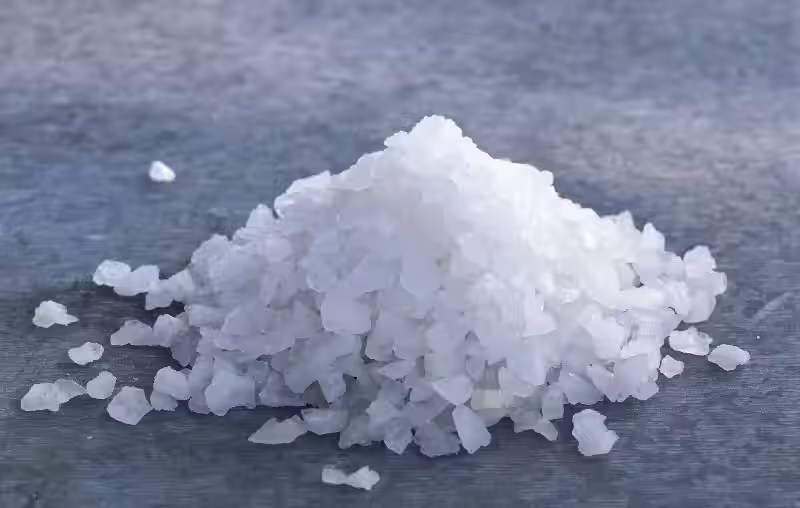
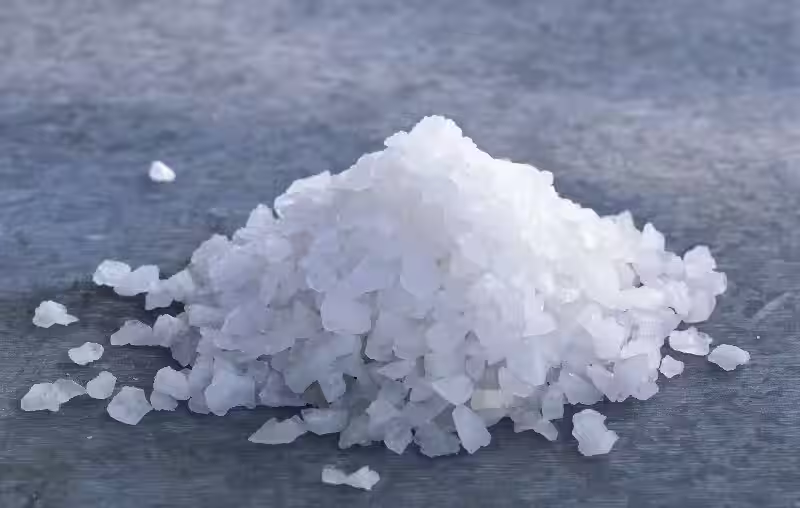
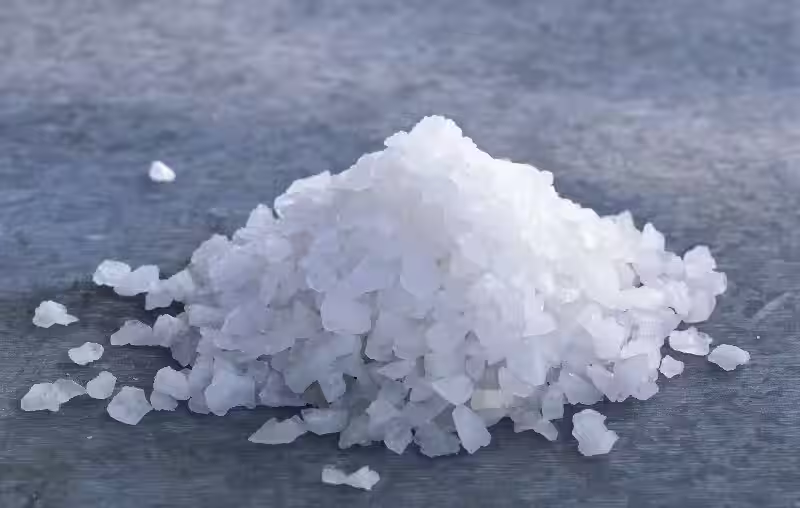
Sodium tetrahydroxyborate (NaH₄BO₄ or Na+[B(OH)₄]⁻) is a colorless crystalline salt, one of several sodium borates. It's characterized by its tetrahedral tetrahydroxyborate anion, [B(OH)₄]⁻, formed by adding a hydroxide ion to boric acid, B(OH)₃. While its elemental ratio suggests Na₂O·B₂O₃·4H₂O, its actual structure is significantly different.
What are its structural forms?
Two anhydrous crystalline forms exist: monoclinic and orthorhombic. The monoclinic form crystallizes in the P2₁/a space group with layered tetrahydroxyborate anions held by hydrogen bonds. Sodium cations are within these layers, coordinated by five oxygen atoms. The orthorhombic form (P2₁2₁2₁ space group) shows anions in (010) layers with parallel B-O bonds, alternating 180-degree rotations between layers. Sodium atoms again lie between anion layers, coordinated similarly.
How is sodium tetrahydroxyborate synthesized?
Synthesis involves slow crystallization from aqueous solutions. The monoclinic form can be obtained from a mixture of sodium hydroxide, boric acid, calcium hydroxide, and water. The orthorhombic form crystallizes from a sodium hydroxide and boric acid solution (pH 12, 3:2 boron to sodium mole ratio) as thin needles. Evaporative crystallization of sodium metaborate tetrahydrate solutions is another method. Raman spectroscopy has been used to study crystallization from nanometer-sized droplets.
What is the stability of sodium tetrahydroxyborate?
Sodium tetrahydroxyborate is relatively stable but reacts gradually with atmospheric carbon dioxide. It's also a hydrolysis product of sodium borohydride (NaBH₄) at 45–65 °C, proceeding through borane (BH₃) and then boric acid formation.
What are the key differences between the monoclinic and orthorhombic forms?
The main difference lies in the arrangement of the tetrahydroxyborate anions. In the monoclinic form, anion orientations alternate within layers. In the orthorhombic form, anions within a layer share a similar orientation, but this orientation is opposite in adjacent layers. This difference arises from the complex interplay of hydrogen bonding and cation-anion interactions.
What are the potential applications of sodium tetrahydroxyborate?
Further research is needed to fully explore its potential applications. The provided information does not detail specific applications.
What techniques are used to study sodium tetrahydroxyborate?
Raman spectroscopy has been used to study the crystallization process, particularly from nanometer-sized droplets. X-ray crystallography is implied by the descriptions of the space groups of the crystalline forms.
Where can I find more information on sodium tetrahydroxyborate?
Further research in scientific databases (like Web of Science or Scopus) using keywords like "sodium tetrahydroxyborate," "sodium borate," "crystal structure," and "borate anion" will yield more detailed information. You may also find relevant information in chemistry handbooks and specialized journals.